





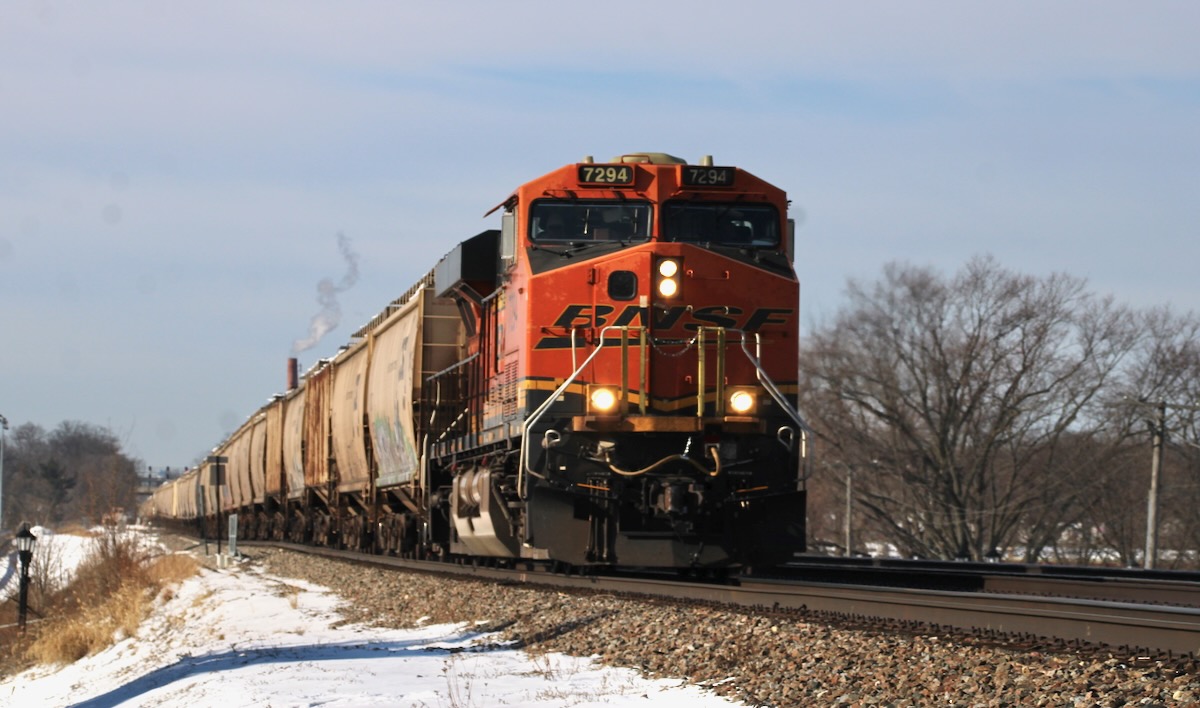
SAN DIEGO, Calif. — Environmental group San Diego Coastkeeper has announced an agreement with BNSF Railway for development of rules for safe transportation of plastic pellets, also known as nurdles — the raw material for the production of almost all plastic products.
The agreement, announced Thursday, Feb. 5, also involves the Coastal Environmental Rights Foundation and North County Transit District, operator of Coaster commuter trains and owner of the Surf Line route used by BNSF along the San Diego County coast.
The pellets are roughly the size of a lentil, and are difficult to clean up in the event of a release. BNSF’s new policies require customers to seal both loaded and unloaded cars that transport the pellets, and say the railroad will not handle non-compliant cars, with escalating fees for non-compliance. The railroad is working with the Association of American Railroads and pellet shippers and receivers to develop best practices for pellet transportation.
“BNSF remains dedicated to its industry-leading efforts to ensure that railroads are the most environmentally preferred mode of surface transportation and thanks CERF and Coastkeeper for the constructive collaboration to address these issues,” Scot Bates, assistant vice president, chemicals and plastics at BNSF, said in a press release.
Patrick McDonough, senior attorney at Coastkeeper, called the agreement “a significant win for our oceans, both globally and locally. With an estimated 25 to 30 billion nurdles entering our ocean each day, we’re thrilled BNSF and NCTD have joined Coastkeeper and CERF to take a leadership role in tackling this crisis.”
The agreement settles a legal dispute dating to 2024, when Coastkeeper and CERF announced the intent to sue BNSF, saying the railroad was violating the Clean Water Act because of nurdles spilling or leaking from freight trains.
— To report news or errors, contact trainsnewswire@firecrown.com.



Those nurdles stay around forever. A railcar repair facility I work for occasionally has that stuff surfacing all the time. It’s been there for years and is mixed into the soil. The current owner of the facility has never cleaned or repaired cars that had been used to transport nurdles. The covered hoppers they deal with are used for grain or food products. Those nurdles eventually work their way into the storm drains or drainage ditches. It is a serious problem.
If these stray nurdles are so immune to breaking down, and/or so immune to absorption into the local soils, that they survive to wash into the ocean, then they’re also inert once they reach the ocean.
In other words, say I have a plastic item somewhere within reach. My pen, my keyboard, the case of my computer, the computer mouse, the faceplate of the room’s light switch, the IKEA cup holding my morning apple juice, my eyeglass frame and lenses, polyester blended with the cotton in my pajamas, the arms of my desk chair? Suppose I threw any/ all of these items onto the side of the street. It would be litter, and that would be unforgiveable. But would it be an ecological problem in the chemical sense? No. I seem to be doing fairly well having all of those items within reach of me today.
We can’t have it both ways, to say that plastic is everywhere including on our person, but it’s an ecological disaster by the side of the railroad tracks.
Charles, I believe the concern about the plastic in the oceans is that aquatic life thinks it is food and eat it. Like you I live with plastic all around me but I don’t try to eat it.
There’s kind of a worldwide panic over microplastics, as plastic materials break up into microscopic particles that are being found everywhere, including inside animals and people.
I am reluctant to challenge Charles, but it DOES seem practical what Powell/Ray mention.
Further I have read microscopic samples of plastic are found in our bodies. Seems that should not be, howerver it shows the prevelance/concern of this item.
As an aside, my janitor at school brought me rhe pellets fearing the kids had drugs in their lockers. A local plant unloaded (spilled) hopper cars of same. endmrw0210261319
I had Google AI try to make sense of the “25 to 30 billion nurdles entering our ocean each day,” and it came up with approximately 1100 cubic meters, or broken down to railroad terms, 7 to 8 fully loaded hoppers. So, they’re saying that BNSF and the pellet manufacturer are okay with losing up to 8 rail cars worth of product every day? I call total BS.
BNSF and Union Pacific have received a lot of complaints in that area because these Harbor cars are not sealed properly. Polystyrene is easy to work with when it is in sheet form, but when it’s in its raw form those pellets are the size of beads and they stick to everything and they cannot be removed. All hopper cars transporting polystyrene must be properly sealed and their outlet hatches closed because if that stuff is released it can get into water, It can contaminate the ocean, and in the event of a derailment it’ll be impossible for it to be cleaned up so they have to make sure that everything is sealed properly before they transport it.
Can we expect the shippers to go to court to fight these restrictions? Anything to save a buck.