Wondering what you might have missed this week in the rail industry? Look no further. The following are the best-performing TrainsPRO stories for the week of Mar. 13, 2026.
Canadian union wins ruling requiring CN to reopen shop facilities, hire workers
Transcona wheel shop, closed during pandemic, must be improved, with workers compensated, arbitrator determines
By David Lassen
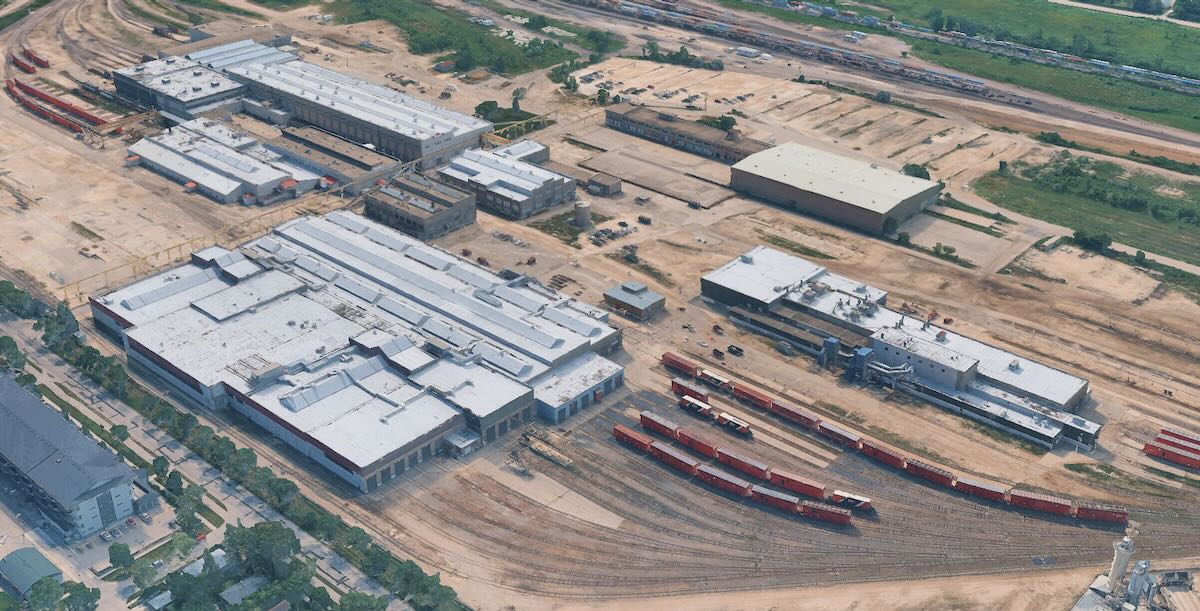
WINNIPEG, Manitoba — An arbitrator has ordered Canadian National to reinvest in its Transcona Wheel Shop, return work to in-house, and compensate affected workers, the Unifor union said today.
The ruling stems from CN’s closure of the wheel shop, traction motor shop, and air brake shop at the yard in Winnipeg during the COVID-19 pandemic in May 2022, with work then contracted out. The arbitrator ruled that CN violated its collective bargaining agreement with Unifor by failing to notify the union, to consult with it before moving ahead, and by undermining its ability to protect its members’ work. An earlier ruling found the violations were serious, not technical; a ruling on March 3 determined the remedy.
“This ruling is an important win for Unifor members and for the future of union rail work across the country,” Unifor National President Lana Payne said in a press release. “… The ruling forces real reinvestment, restores core union work, and sends a clear message that companies cannot erode Canadian industrial capacity without being held to account.”
The ruling requires CN to modernize the wheel shop, restore production to meet or exceed pre-shutdown levels, and hire at least 20 new union employees. It does not require reopening of the air brake and traction motor shops, but specifies that CN must bring 85% of heavy bad-order locomotive work back in-house in Canada. The majority of that work will remain at Transcona.
“The order to rebuild Wheel Shop production, add bargaining unit jobs, and keep this work here at home is about protecting livelihoods, preserving skills and community pride,” said Gavin McGarrigle, Unifor western regional director.
CN declined to comment on the developments.
Unifor is Canada’s largest private-sector union, representing 320,000 workers across the economy.
California Zephyr, Southwest Chief suffer extraordinary mechanical delays over weekend
Aging equipment continues to succumb en route; Amtrak declines to address details
By Bob Johnston

CHICAGO — Late arrivals are, to a degree, preordained for Amtrak’s long-distance trains on the first weekend of Daylight Saving Time — but not to the extent experienced by the California Zephyr and Southwest Chief.
When clocks advance by one hour every spring (except in Arizona, which does not observe Daylight Saving Time), Amtrak trains that may be on time at 2 a.m. local time become one hour late, unless a special schedule is implemented, using a different train number, that accounts for the time change. In that case, times are adjusted by one hour at stations the train serves after 2 a.m. Sunday.
Service marginally impacted by last weekend’s hour loss includes eastbound of the Empire Builders arriving Tuesday, March 10, and today (March 11) in Chicago. Both had their already-short 5½-hour equipment turnarounds reduced by an hour, reflecting tardy westbound arrivals that dealt with high wind warnings and freight congestion. Both departed two hours behind schedule; Tuesday’s arrival in Chicago was at 8:14 p.m., 3 hours, 29 minutes late.
Chief hobbles west
Southwest Chief No. 1003 that departed Chicago on Saturday, March 7, was another story. The train was given an extra hour to get to Los Angeles, with a scheduled arrival of 8:57 a.m. Pacific Daylight Time on Monday, March 9. The fact that it arrived at 10:40 p.m., 13 hours, 43 minutes late, is symptomatic of increasing issues of breakdowns en route for the long-distance trains.
Troubles began at Albuquerque, N.M., according to alerts shared with passengers. The lengthy stop, a 1,500-mile inspection point, is where “equipment adjustment and removal” took place. The resulting 90-minute pause, however, was dwarfed by a five-hour, 15-minute stop at Gallup, N.M. Another two-hour delay came between Gallup and Winslow, Ariz., and three hours more were lost at Kingman, Ariz., while the train waited for an operating crew to relieve compatriots whose federally mandated hours-of-service limits had expired. “Mechanical assessments” at Albuquerque and subsequent crew transport had similarly combined for a six-hour delay to the westbound train the previous Thursday.

Zephyr delays
An Amtrak alert also revealed that an “ongoing mechanical concern” befell the westbound California Zephyr departing Chicago on March 6. The train was delayed four hours between Green River and Provo, Utah, “and will be met at Salt Lake City by the mechanical team who will further evaluate this concern,” according to the unusually candid alert. The train arrived Sunday morning at 4:55 a.m. and departed at 8:15 a.m., by then seven hours, 35 minutes late.
While the beleaguered westbound Zephyr was in the Salt Lake City station, its eastbound counterpart No. 1006 arrived early, but departed two hours, 20 minutes late, following “equipment adjustments and removal.”
Trains asked Amtrak for more specifics on the issues of both trains on Monday, March 9, but the railroad has yet to respond.
Such incidents are becoming a regular occurrence.
- On March 2, the eastbound Chief lost two hours setting out a sleeping car at Galesburg, Ill. With only one sleeper currently assigned [see “Amtrak adds train capacity …,” Trains.com, March 6, 2026], passengers moved to the Sightseer Lounge for the remainder of the trip into Chicago.
- The same day, the City of New Orleans departed the Windy City on time, but had to “revert back to Chicago due to mechanical assessments concerning the locomotive.” It departed again at 11:08 p.m. instead of 8:05 p.m.
- On March 3, an Empire Builder coach was bad-ordered after the westbound train’s equipment had moved to a Chicago Union Station platform; the subsequent swap resulted in an 8 p.m. departure, a nearly five-hour delay.
These problems are not limited to Superliner-equipped trains. On Monday, after leaving New York 32 minutes late, the southbound Silver Meteor lost an hour to “equipment servicing and adjustments” at Washington, D.C. It fell further behind after “equipment adjustments and removal” at Richmond, Va., as well as “signal outages, freight train interference, and crew conducting locomotive assessments” elsewhere, and arrived in Miami today (Wednesday, March 11) at 1:17 a.m., 6 hours, 18 minutes late.
The fact the vast majority of Amtrak trains leave their terminals in good shape and operate on time is a testament to mechanical forces that keep the company’s aging rolling stock in motion. But last weekend’s events show that an increasing number of significant breakdowns en route are disruptive on a far-flung network that has few current options for equipment substitution.
Appeals court says administration must continue Hudson Tunnel payments
Panel upholds restraining order that released funds
By Trains Staff
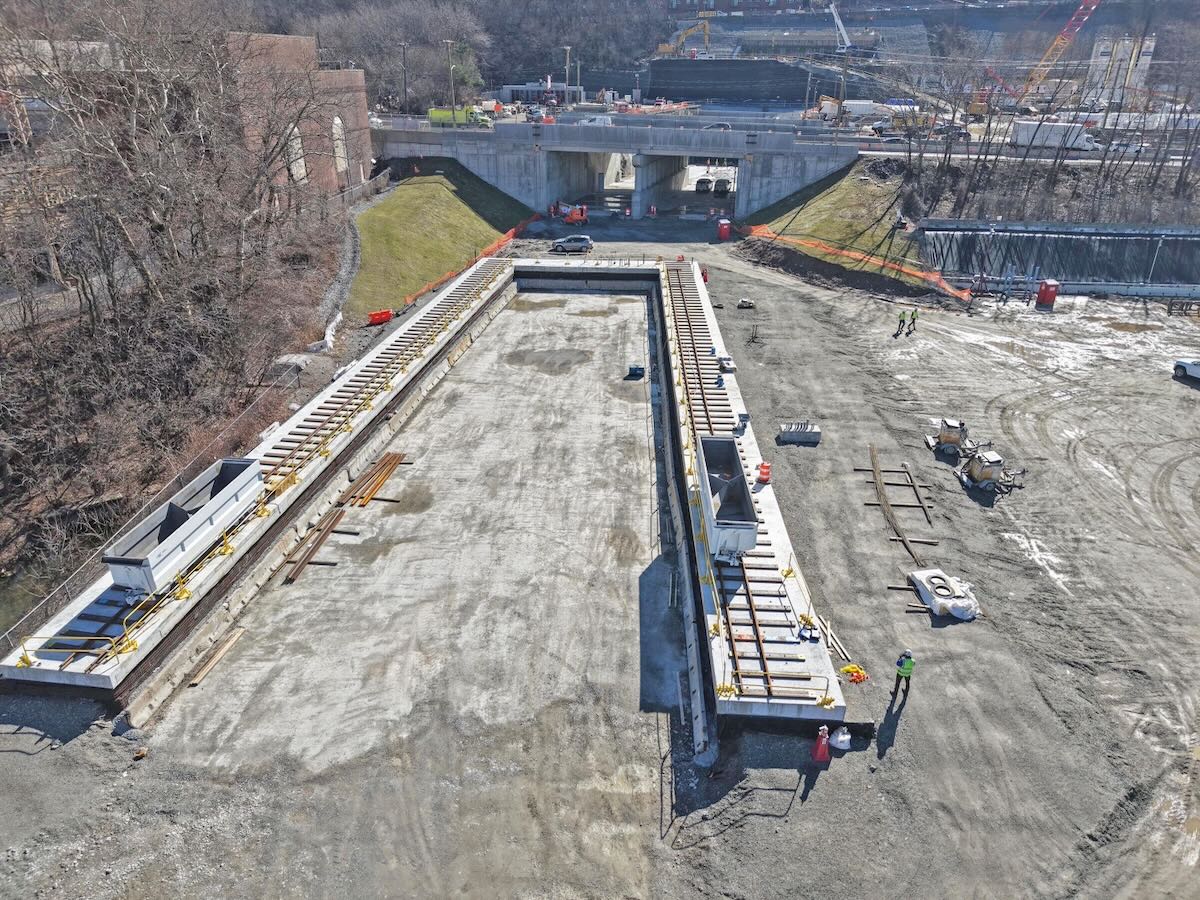
NEW YORK — The Trump administration has lost another round in court over funding for the Hudson Tunnel rail project, with a federal appeals court rejecting the administration’s bid to halt payments.
Reuters reports a three-judge panel of the 2nd U.S. Circuit Court of Appeals ruled, in the suit brought by the states of New York and New Jersey, that if it agreed to lift a temporary restraining order, the federal Department of Transportation could suspend future payments, leading to a halt to construction “posing serious risk of injury and deterioration that the states, at considerable expense, will become responsible to safeguard against.”
New York Gov. Kathy Hochul noted the decision in a brief social media post, calling it “Another loss for Trump. Another win for New Yorkers.”
The Department of Transportation indicated it was considering a further appeal, Reuters reported, saying it was committed to ensuring taxpayer dollars “are being spent responsibly. We are considering all legal avenues” on taxpayers’ behalf.
The ruling upheld an earlier decision by U.S. District Judge Jeannette Vargas that had released funds withheld since October [see “Judge orders funds released …,” Trains.com, Feb. 7, 2026]. Work on the tunnel, which halted on Feb. 6 because of a lack of funds, has since resumed, but the Gateway Development Commission, which oversees the project, has warned it could stop again without assurance the project has access to the full $16 billion previously committed by the federal government [see “Hudson Tunnel work has resumed …,” March 10, 2026].
Progress Rail to convert 96 Norfolk Southern SD70Ms to AC-traction SD70ICCs
The first modernized units will be delivered in 2027
By Bill Stephens
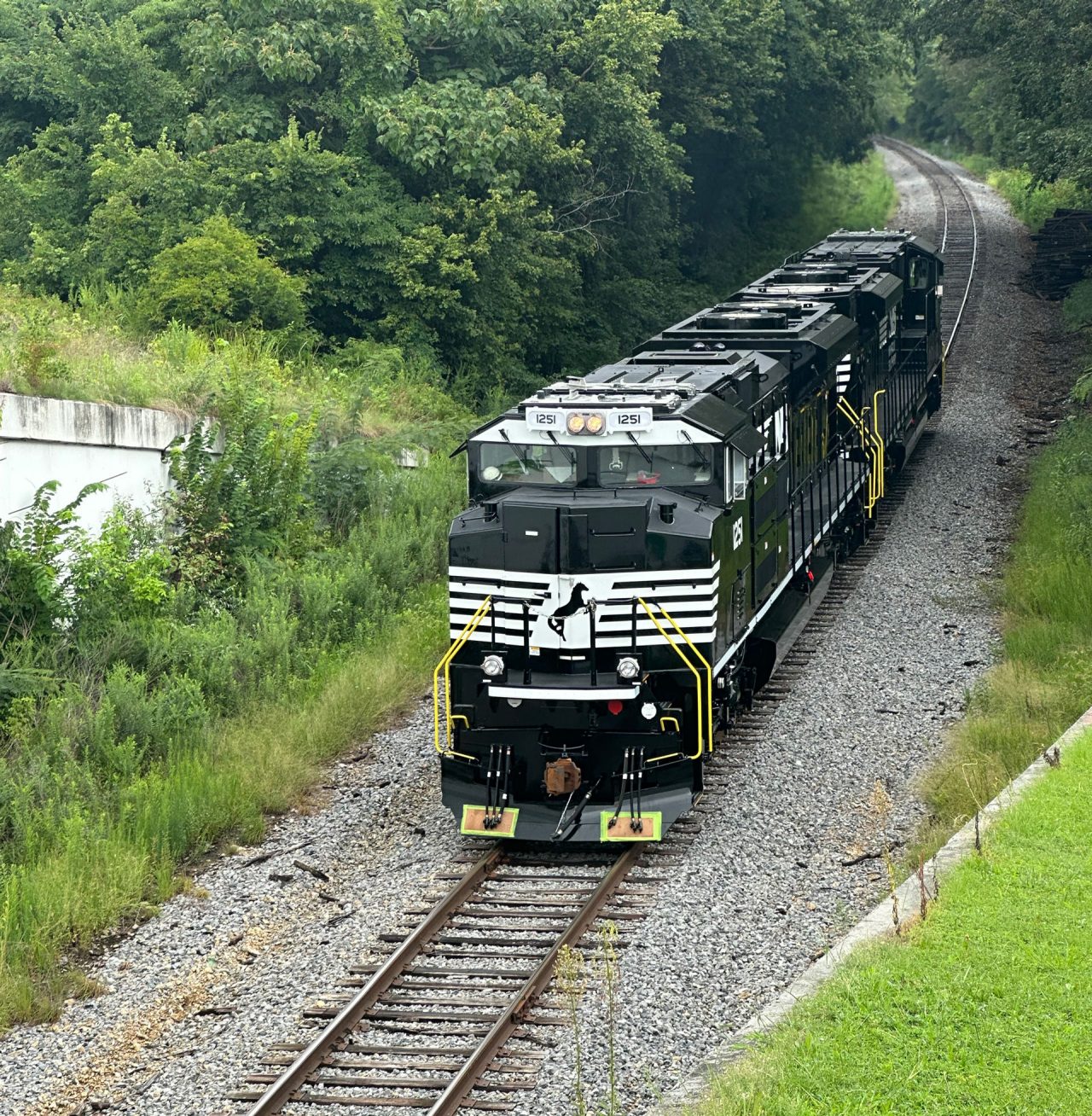
ATLANTA — Norfolk Southern will continue to modernize its locomotive fleet in a deal announced on Monday with Progress Rail, which will convert 96 of the railroad’s SD70M-2 models to AC-traction SD70ICCs.
Deliveries of the Tier 2 locomotives will start in 2027 and run through 2029.
“By modernizing existing units, Norfolk Southern is taking a significant step toward a more efficient future,” Jack Zhang, locomotive executive vice president at Progress Rail, said in a statement. “Our SD70ICC conversions deliver the performance and reliability railroads need while helping them meet their sustainability goals. This order underscores Progress Rail’s commitment to providing innovative solutions that help customers strengthen performance across their network.”
With the upgraded design, three modernized SD70ICC units can do the work of four legacy SD70M-2s, allowing NS to move the same tonnage with fewer locomotives, Progress Rail said.
The upgraded locomotives will feature:
- Individual axle control for superior traction.
- Caterpillar Advanced Diesel Engine Management (ADEM) for improved performance.
- Remanufactured 16‑cylinder EMD 710 engines producing 4,300 horsepower.
NS said the SD70ICCs will be 40% more reliable than the SD70M-2s, increase haulage capacity by 55%, and improve fuel efficiency by 3%. The modernizations extend the life of each locomotive by 20 years.
“These conversions are a tangible example of how we’re modernizing our fleet to drive safe, reliable, and efficient operations for the long term,” NS Chief Mechanical Officer Brian Barr said in a statement. “By upgrading to AC traction, we’re strengthening network resilience, improving fuel efficiency, and extending the life of our assets — while giving our customers greater haulage capacity and the consistent service they need to support their own growth and sustainability goals.”
Through a combination of DC-to-AC modernizations, new locomotive orders, and retirements NS aims to reduce the number of models in its fleet to four from the current 13.
Today, nearly 90% of the railroad’s in-service road locomotives are AC traction, and the entire fleet uses energy management software, making NS the only railroad using the fuel efficiency technology across its entire roster.
Union Pacific’s Vena says merger critics need to ‘quit looking backwards’
CEO says quality, not just numbers, matter in assessing deal with Norfolk Southern
By Stuart Chirls
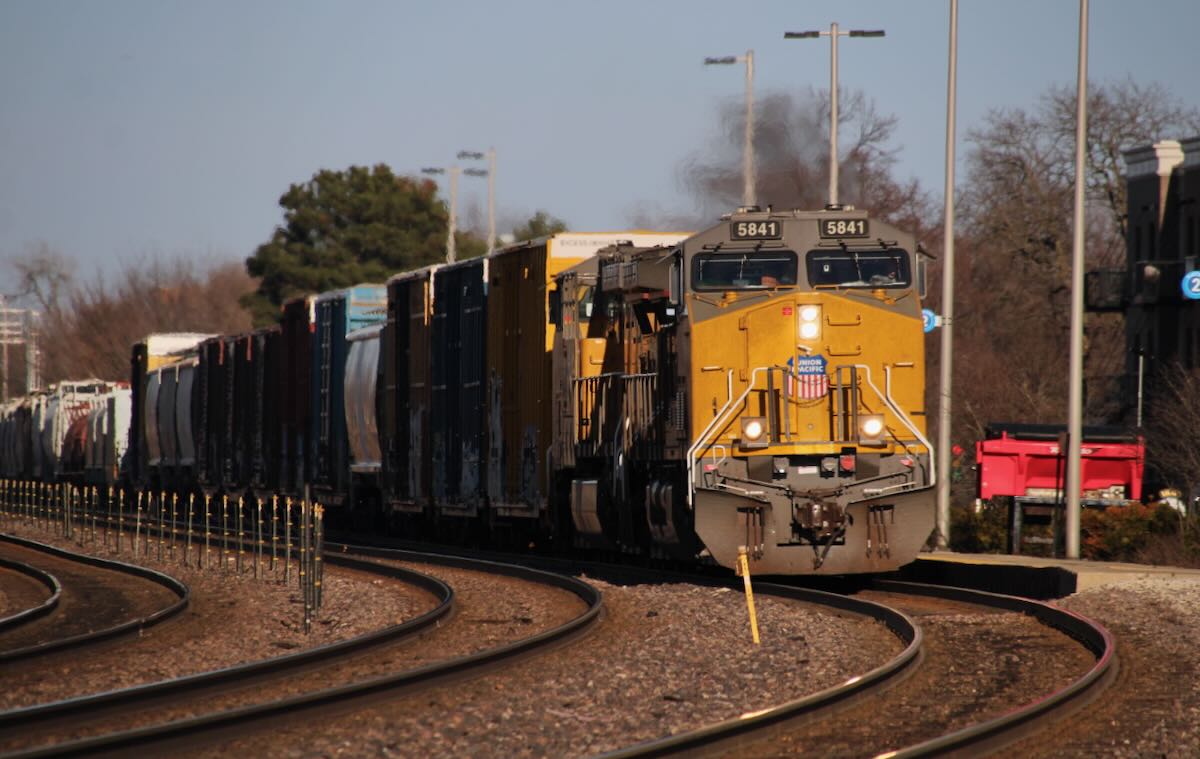
OMAHA, Neb. — In “The Tempest,” Shakespeare wrote, “what’s past is prologue,” meaning history sets the context for the present and dictates future events. Except, apparently, when it comes to transcontinental railroads.
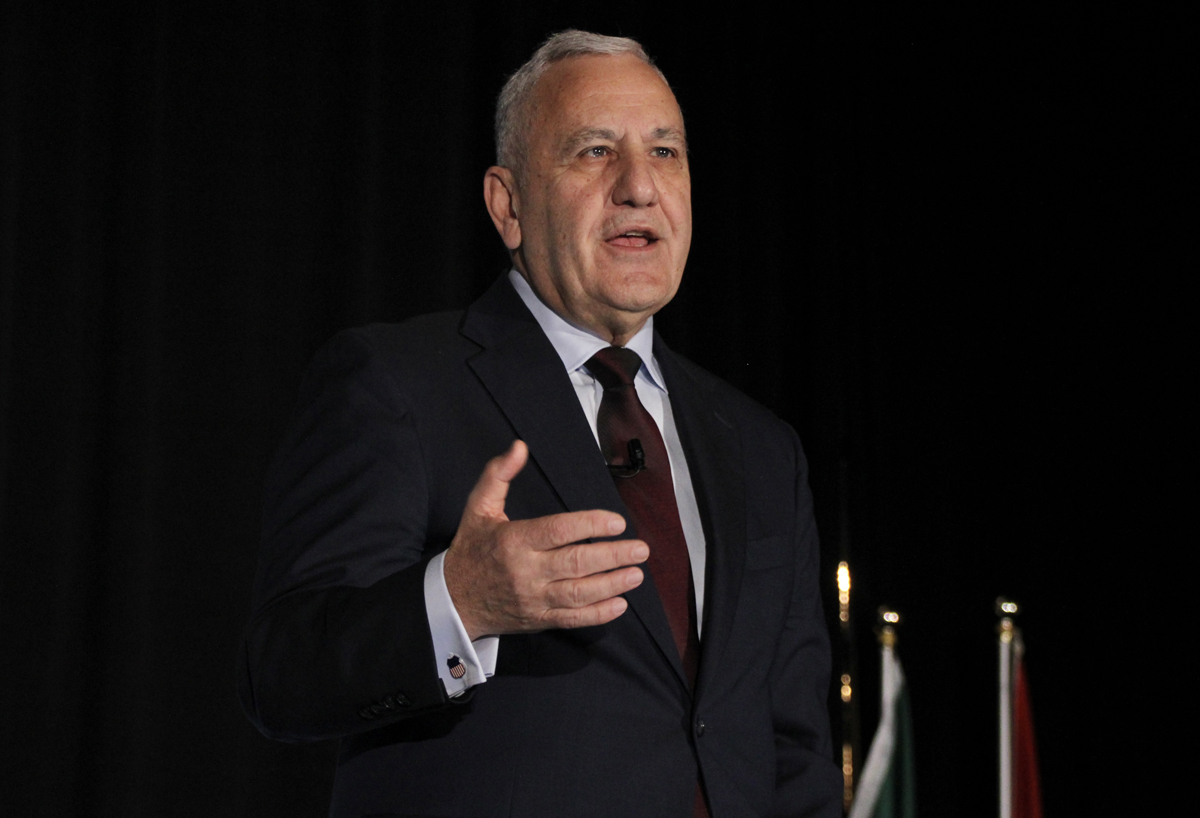
In an exclusive interview with Firecrown Media news site FreightWaves, Union Pacific CEO Jim Vena fired back at critics of his company’s blockbuster merger with Norfolk Southern, insisting it won’t have the lasting price and service issues that have accompanied past transportation consolidations even as it reshapes the U.S. supply chain.
“People have to quit looking backwards and look at what’s possible,” Vena said by phone from UP’s Omaha headquarters.
Union Pacific has faced withering criticism from industry observers who declared the math supporting the $85-billion transaction with NS didn’t add up.
But Vena said it was a “mistaken view” to see it just through the numbers. “You have to look at the quality aspect, as well. The people and companies that manufacture and produce the goods we consume every day, we want to be able to give them a better rail system, one that allows them to compete against the world.”
At the same time, numbers are at the crux of the merger proposal: 1.4 million truckloads converted to intermodal in 36 months, and 2 million truckloads diverted to rail annually.
More numbers: The railroads say the merger will shave up to two days off a typical five- to seven-day journey for railcars moving from coast to coast. That’s a game-changer making rail competitive with transcontinental freight moving by truck. Some industry executives have said privately that the time savings could be even greater. The single-line route will also open up the Midwest watershed, where rail has long grappled with a tangle of competing lines and interchange issues.
The questions surrounding UP-NS only intensified after the Surface Transportation Board turned down the initial merger filing as incomplete [see “Regulators reject UP-NS merger application …,” Trains.com, Jan. 16, 2026]. The board made requests for more information, including forward-looking market data and agreement details.
The companies expect to file an updated application by April 30.
Vena defended not including some data for competitive reasons — “you have to be careful you don’t give everything away to your competitors” — and repeated assertions that the vast majority of long-term growth will come from taking share away from trucks. But some analysts took issue with the railroads in the application categorizing dray-to-rail conversions and rail-to-rail market share shifts as growth, instead of just truck-to-rail and the opening of all-new markets.
Vena fairly bristles at the critiques, and questions some credentials.
“It’s always easy to be on the negative side if you’re not out to deliver,” said Vena, pointing out that UP is atop industry analytics for efficiency, revenue and safety. “Our people are comfortable with what’s there and the data we have calculated.”
The company also redacted Schedule 5.8, which specifies “Materially Burdensome Regulatory Conditions” that would allow UP to walk away from the deal.
“With a transaction as large as ours, there will always be protection for both sides,” says Vena, who compared it to the contract terms for the 17 homes he and his family have lived in during his railroad career. “At some point we have the right to walk away, we have an out. But there’s no walking away without a penalty. If the STB had told us to put it [the terms] out, we would have. We asked them to keep it confidential; it’s up to them. Why would you ever tell your competitors the financial details? It’s ridiculous, it really is. They would love to see what we have.”
The STB recently proposed a reset of reciprocal switching rules, which if approved would give some shippers a choice of rail carriers. Vena says that’s not a condition to scrap the merger. “I’m all for reciprocal switching, it gives optionality. I’m glad the STB came out with that reset.”
Growth and competition
Asked about UP’s recent history of low volume growth, Vena says a focus on service can help optimize what the railroad can do, and answer the STB’s “higher bar” requirement that a merger not only preserves competition, but enhances it.
“We’re a strong and well-run company,” Vena says. “Today, we have a low double-digit share of freight that is is moved every day in America. That’s a lot of tonnage. At the end of the day, we have to ask, does it make movement of goods more competitive? It will be better for the customer, and better for the country. We have to deliver more optionality and be able to take trucks off the highway, and that’s what we’re doing. To make shippers more competitive in the markets they’re in, we need to understand that market, and we need to win with our customers.”
Long term, Vena says, “50% of UP’s business is intermodal, and the merger will bring that segment to a whole new level of capability, so you need to tackle that, that’s where the growth is. We continue to work with customers to open up new markets, and spend capital to give them optionality. We’ve developed a steel plant in Phoenix, new chemical plants in Louisiana, new facilities across the network for intermodal.”
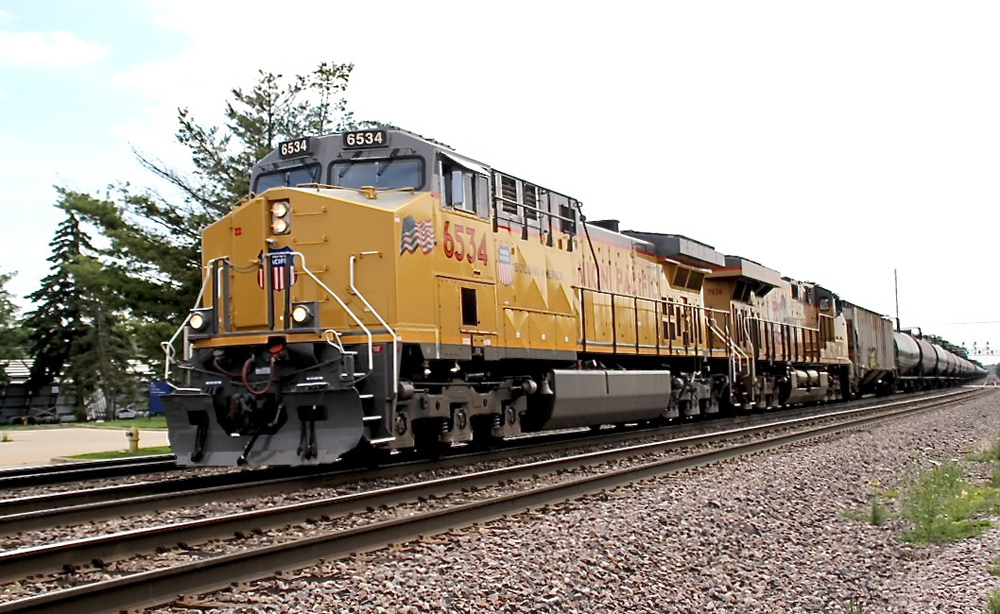
Vena said UP will continue to be efficient with its outlay for motive power, and will rebuild older locomotives rather than buy new. Union Pacific and Wabtec announced an agreement last month to modernize UP’s AC4400-series locomotives, the fourth such rebuild program since 2018 [see “Union Pacific, Wabtec sign $1.2 billion deal …,” Feb. 4, 2026]. That will bring the carrier’s total to more than 1,700 rebuilt units.
“We’re still spending a lot to modernize, from the frame up, like new,” says Vena, a former locomotive engineer. “That is way more cost-effective, delivers onboard components, fuel efficiency, and reliability. We’re very comfortable doing that. If there was a product that was substantially better, we’d buy it. The plan is to continue to modernize.”
Vena pointed out that the railroad has 1,500 “excess” locomotives.
Still, the recent history of transportation mergers among airlines and railroads isn’t a study in customer-facing benefits where fares, rates, and choices are concerned. Vena points out that railroads have succeeded despite the structural limitations of a heavily regulated, capital-intensive industry.
“The cost structure of railroads over the past 20 years is nowhere near inflation,” he says. “Our customers are very large and very sophisticated companies — Cargill, Exxon, ADM, Chevron, Walmart, Fedex, UPS — major internationals, and they push every year to help them be better in the marketplace. We always ask, ‘What service are we providing, and how can we make that better?’ My God, as a business, where do we go? Always look to be operationally efficient in how you use your assets, faster, with more fluidity, and less touch points [per railcar].”
As for service issues, Vena said that, sometimes, the railroad has to work with what it’s given.
“Railroads aren’t precision operations because customers aren’t always precise, and you don’t know what they’re going to give you on a daily basis. People need to get off of this ‘driven by OR [operating ratio]’ thinking. That’s not what drives us,” Vena says.
Asked about Ancora, the activist investor that helped bring about leadership changes at NS and CSX, Vena says, “At the end of the day, companies that are well-operated that fulfill and look for the greatest opportunity to deliver for shareholders and customers, and be the best in the industry, no activist will ever be able to take that company on. The American system of capitalism makes people look at companies that aren’t performing in the marketplace. It keeps your feet to the fire, to deliver as a CEO, that’s your job.”
As far as NS, “There are always going to be activists who are not being fair about what they’re doing. Shareholders vote and decide whether management has a good plan or not. The outcome of the [Ancora] campaign was that the management team proved to shareholders they had the right plan moving ahead.
“There is not another system that’s better.”
This article originally appeared at FreightWaves.com. To report news or errors, contact trainsnewswire@firecrown.com.
— To report news or errors, contact trainsnewswire@firecrown.com.