





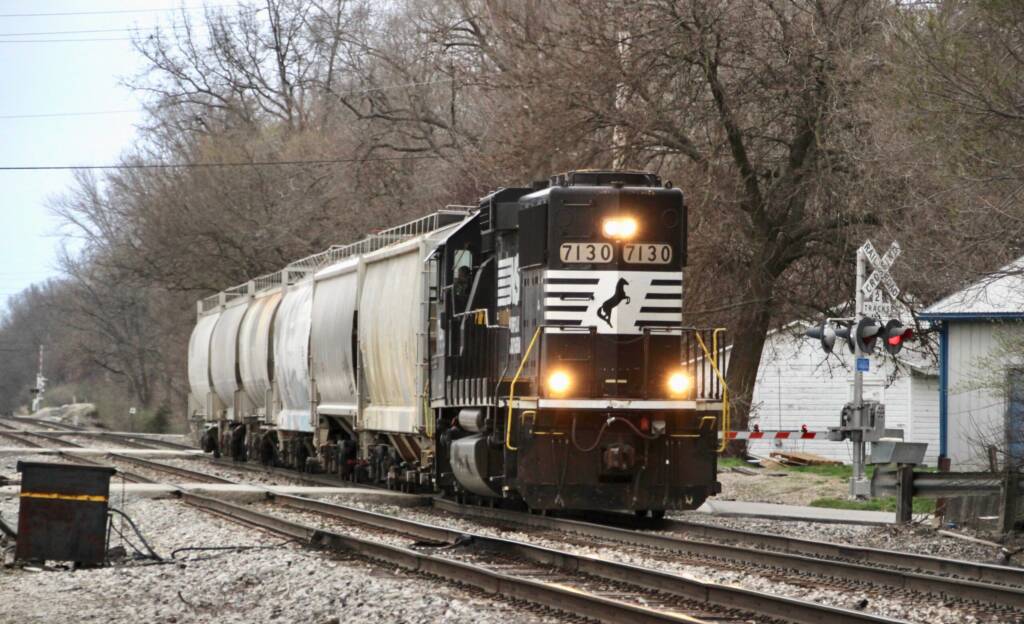
WASHINGTON — Shippers this week cheered the Surface Transportation Board’s proposal to boost rail competition, while railroads offered a range of nuanced responses to limit how future rate cases should be addressed without explicitly rejecting reciprocal switching.
The STB in January said it aims to repeal regulations that since 1985 have effectively prevented sole-served carload and bulk shippers from seeking access to a second railroad [see “STB proposal…” Trains.com, Jan. 7, 2026].
The regulations cover reciprocal switching, through routes, and through rates. The STB’s Notice of Proposed Rulemaking would jettison Part 1144 of the federal code of regulations, which currently requires shippers to demonstrate “anticompetitive conduct” and meet other requirements to obtain relief from the board.
“Removing Part 1144 will create new opportunities for competition in the rail industry to be a key mechanism to improve rail service and solve freight rail challenges for the benefit of U.S. manufacturers, farmers, distributors of raw materials, and the American economy,” the National Industrial Traffic League, an umbrella shipper group, told the STB in a filing this week.
NITL and other shipper associations have pressed the STB for reciprocal switching for decades.
Two other shipper comments illustrated how shippers viewed the board’s plan to repeal the regulations.
“The proposal adheres to the statutory language and has the potential to result in meaningful competition, lower rates, and improved service, none of which can be said of the status quo,” according to the umbrella group Freight Rail Customer Alliance and the National Coal Traffic Association.
The American Chemistry Council called for rate relief, saying that rail rates where shippers don’t have a choice of carriers have increased by 265% in the past 20 years, compared with a 49% rise in rates where competition exists, citing a study by Escalation Consultants.
On the subject of through routes and rates, the American Petroleum Institute said it “supports full repeal. There is no policy justification for retaining regulatory barriers in one area (rates and routes) while eliminating them in another (switching). A unified return to statutory standards promotes coherence, predictability, and fairness.”
Union Pacific said it “supports competition and understands that shippers with longstanding service problems should have access to remedies that will improve their service.”
The railroad seeking to acquire Norfolk Southern also said “the Board must ensure that the remedy (reciprocal switching) demonstrably improves service, does not disrupt overall network fluidity or operational efficiency,” adding that the remedy should apply to high-volume shippers.
Other railroads’ comments were more guarded.
CSX and Norfolk Southern questioned the legal underpinning and STB’s reasoning in potentially removing Part 1144 altogether.
“A regulatory framework that allows competitive access to be prescribed on demand or with a lowered standard would both undermine future investment incentives and undercut investments made,” CSX asserted.
Norfolk Southern questioned whether there was a need to overhaul Part 1144.
“Rescission (of 1144) would create a vacuum of guidance, leaving rail carriers with no basis for assessing either the likelihood that a prescription might be imposed or even the likelihood that a shipper would seek one,” NS said.
The two Canadian-based Class I railroads did not mention interswitching, Canada’s active version of reciprocal switching, which allows introduction of a second railroad to create competition in some circumstances.
Canadian Pacific Kansas City said Part 1144 “has underpinned a stable regulatory framework” for four decades, and claimed “any repeal of Part 1144 in favor of a case-by-case approach to developing the new standard would engender greater uncertainty.”
A case-by-case approach, CPKC argued, would create “more regulatory interference, not less.”
The result, its filing said, would be to effectively increase regulation.
Canadian National’s filing urged limitations, such as not allowing reciprocal switching for contract shipments or so-called “exempt” shipments such as intermodal, or moves beyond terminal areas.
In its filing, BNSF warned of potential negative operational consequences. “Widespread use of access remedies that ignore real-world competitive forces would cause operational problems that negatively impact all shippers on BNSF’s network,” BNSF said.
The railroad urged the STB to narrowly tailor its intervention “to solve specific, identified problems with the functioning of relevant markets.”
BNSF, which opposes the UP-NS merger, also urged the STB not to make a ruling in the Part 1144 case that would help the UP-NS merger to go forward.
A particular difference of opinion crossed the shipper-railroad boundary on whether to proceed with a full rulemaking or a faster approach called a “guidance document” that STB offered as an alternative.
Union Pacific favored a guidance document, as did shippers such as the American Petroleum Institute.
On the other hand, CPKC said, “the Board should clarify its regulations within the confines of the statutory framework and in accordance with legal precedent, and it should do so in the context of a formal rulemaking.”
Proceeding on a case-by-case approach also raised questions, as did switching that’s confined to terminal areas.
CN questioned a case-by-case approach, and cited complications that would arise from a guidance document.
The U.S. Department of Agriculture said “shippers need assurance that … the case will be decided in a predictable and timely manner.”
The agency also appeared to favor a case-by-case approach for switching matters, while noting that approach’s drawback of the higher expenses required to build a record. USDA also noted that reciprocal switching cases might need to extend beyond a terminal area because some rural grain elevators are far apart.
Speed also mattered to some. The National Grain and Feed Association’s filing called for a 120-day schedule to “expeditiously decide” reciprocal switching cases.
Unions also had differing views.
The Brotherhood of Locomotive Engineers and Trainmen observed that switching inside or beyond terminal areas posed safety questions because of differences such as different railroads’ rules and radio frequencies. That Teamsters unit also “strongly believes there are other solutions available” to eliminating Part 1144, such as “holding the carriers responsible for regular, reliable service.”
Meanwhile, the SMART-TD union “strongly supports this proposed rule.” The union’s statement said, “Any time a monopoly is broken up, and competition is emphasized in the workplace, American workers win.”
The filings also contained the usual regulatory arguments couched in limitations and qualifications, including one filing that contained a 96-word sentence with seven commas.
— To report news or errors, contact trainsnewswire@firecrown.com.
Share this article
Hi Roger,
As they say, great question on a complicated subject! The arrangements between railroads A and B typically are individual, based on each carrier and industry’s circumstances and facility layout. Depending on what the STB decides in the 1144 proceeding, their ruling could make substantial prescriptions regarding maximum distances, a cost formula and other terms.
In general, an already defined terminal area can be the boundary for reciprocal switching. In Canada, their version of reciprocal switching has a 30-km limit. However, the USDA wants switching outside the terminal area because some grain elevators are far apart. There’s certainly an incentive for all parties not to tie up the mainline for a switch.
Hope this helps at least a little.
How does “reciprocal” switching actually work? Okay, we have Industry A with sidings on railroad A. Industry A wants to be switched by railroad B. Nearest junction between railroads A and B is 25 miles from the industry. Does RR B run a train down 25 miles of RR A to the industry, switch and return? Re trackage rights of some sort? How does a dispatcher on RR A fit this train into its own traffic flow? What is the obligation of RR A to insert these movements into their own tracks? Must the industry trackage be such that ALL switching moves to drop and pick up cars can be accommodated completely off RR A’s main? Is a puzzlement!