





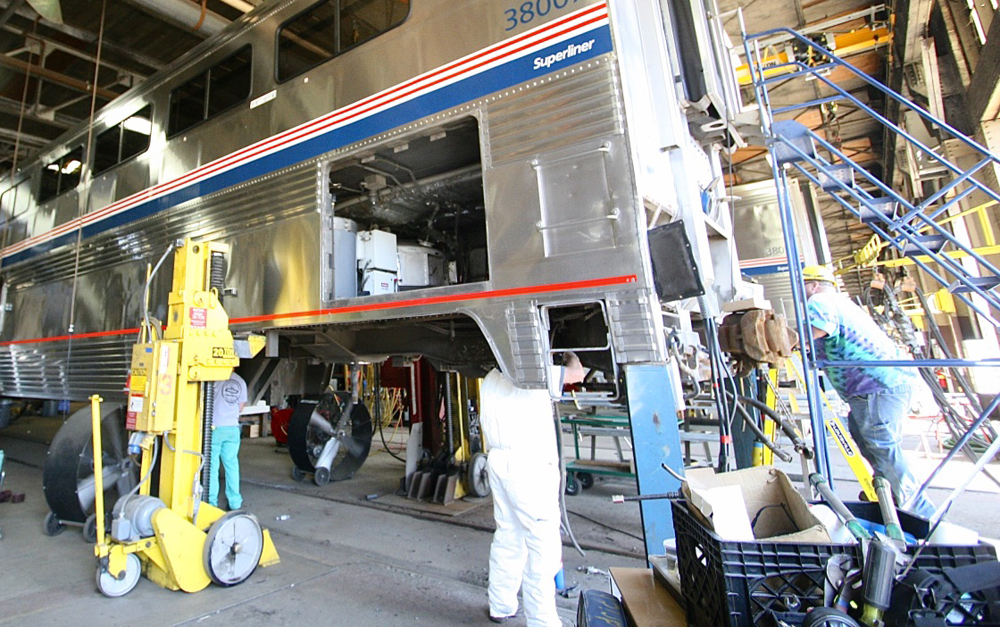
WASHINGTON — Amtrak is scrapping plans for a new generation of bi-level passenger equipment to replace its aging Superliner fleet, announcing that it will instead move ahead with developing a single-level fleet for use across its system.
The company said in a press release that the move reflects “extensive analysis of the challenges associated with operating a hybrid fleet;” industry feedback from its prior proposals on new bi-level cars; and findings from a joint review by Amtrak and the Federal Railroad Administration.
At its Jan. 28 meeting, the Amtrak board of directors ordered management to pursue single-level equipment for the long-distance network, based on a recommendation from the Department of Transportation, sources told Trains.
“This new approach will deliver a more consistent and accessible customer experience across the Amtrak network while maintaining our commitment to introduce the first new long-distance cars in the early 2030s,” Amtrak President Roger Harris said in a press release today (Feb. 26). “Thanks to support from FRA Administrator David Fink and the entire Federal Railroad Administration team, Amtrak’s long-distance fleet replacement is moving forward more effectively and efficiently than originally planned.”
Deputy Transportation Secretary Steve Bradbury said the new equipment means “Amtrak will finally replace its aging fleet and provide American travelers with the world-class rail service they deserve … These new cars won’t just benefit American train passengers, but workers, too, by support good paying domestic manufacturing jobs.”
The railroad said it will issue a formal request for bids on the new long-distance fleet in “the coming months” and cancel the bi-level procurement process. A delivery schedule will be determined once Amtrak chooses a builder.
Amtrak originally sought to buy both single- and bi-level equipment, issuing a request for information from potential builders in 2022 [see “Amtrak seeks carbuilder interest …,” Trains.com, Jan. 19, 2023]. Responses to that inquiry shaped preliminary plans for both types of equipment that were displayed as part of a public hearing on equipment accessibility held in August 2023 [see “Amtrak reveals new long-distance trainset concepts …,” Aug. 30, 2023].
A formal request for proposals came in December 2023; at the time, a railroad spokesman said it was “Amtrak’s highest priority to replace the oldest portion of the long-distance fleet.” [See “Amtrak issues Request for Proposals …,” Dec. 22, 2023]. The first of the Superliners, built by Pullman-Standard, entered service in 1979. A second generation of the cars, the Superliner II fleet built by Bombardier, was completed in 1996.
The procurement process stalled when Amtrak sought features that potential manufacturers had warned against and subsequently rejected, according to the independent Amtrak Office of Inspector General [see “Amtrak Inspector General report …,” Dec. 18, 2024]. Problematic aspects of the order included a request for elevators in the bi-level cars, as well as the desire to have builders deliver complete trainsets of multiple car types.
The bi-level request process has apparently not advanced since, although it originally carried a May 2024 deadline for responses.
— Updated at 12:20 p.m. CT with link to Amtrak announcement. To report news or errors, contact trainsnewswire@firecrown.com.


Hey I have a question . . .
How is VIA building a new dome car?
Does it have an elevator?
On the one hand I see the benefit to fleet standardization and simpler design.
On the other, I’m worried what impact this will have for passenger comfort and sleeper car service. It’s already considerably more expensive to take a long distance sleeper than to either fly or drive. It’s done more for the experience. I’m wondering with the single level fleet how much that’s going to reduce sleeper capacity and increase price.
Traveling the west especially is going to suck when looking at the scenery from low level windows. A difference in seating capacity between sleepers and Viewliner II diners and Superliner diners too, you’d probably need two Viewliner II diners (and their crews) on the CZ, SW Chief, and Empire builder during the summer.
Wonder if it would be possible to make a single-level dome car out of a Siemens or Viewliner II design too? The Viewliner II seems like you could make into a single-level observation/lounge like the “Beach” series?
Sigh. I am disappointed. This seems to be the wrong choice EXCEPT that the bi-level seems pretty clearly to be too complicated for Amtrak to design and procure. Better to have something than nothing.
Perhaps the next generation of equipment can get back to the design standards of the 1950s! I am grateful I got to live most of my adult life with Superliners
(And, if we are really lucky, at some point not too far in the future we might get some dome cars out of the single level design!)
I’m sure that the Amtrak bosses are now patting themselves on the back for making a decision to omit any newly manufactured double-stack train cars. However, they should have instead omitted the faulty idea of putting in ADA elevators on those cars, letting ADA cutomers stay 100% on ground level. The second priority should be to re-vamp the entire nation-wide passenger rail system to accomodate bi-level cars, similar to Finland’s “Santa Claus Express” elctrified bi-level car system. Then you could have a bi-level Auto Train operating from the Boston area all the way to Florida: overhead electric from the Boston area to Lorton, VA. Then Diesel power on to Sanford, Florida. Of course: everyone will say “that’s impractical and WAY too expensive”. I disagree: that’s simply adequate preparation for future rail infrastructure needs.
I’m bummed out about it. I loved, Loved, LOVED, the Santa Fe Bi-Levels and the Amtrak Superliners…. LOVED.
I guess it just leans towards the lowest common car design, and “Fuck” the advantage of Bi-Levels…. I “get” that American ADA makes things more difficult for procurement & fleet maintenance, but the Bi-Levels offered SO MANY advantages…
Damn, if only I could transfer my hundreds of thousands Amtrak points to VIA rail, ( I know asshats, no Bi-Levels…) I would in a NY Minute. But, MAYBE Amtrak will spec out some killer single-level non-rev cars like the old ACL or SEABOARD lounge cars, with windows wrapped around….. or MAYBE some single-level DONE cars? An old fart can dream, can’t we?
I’m sorry, but after the new equipment produced by Amtrak and the diagrams of the proposed single-level fleet, I have little confidence that Amtrak is going to provide a pleasurable experience riding trains in the future.
I.E. Uncomfortable seats, riding backwards, inadequate or no seating in the cafes, seats without windows . . . etc.
Thank you, Richard, for saying what nobody else is. I see people saying things like “I think a nationwide single level system is better” or “It’s time to modernize the fleet” – well are those same people going to take Amtrak when the seats feel like bricks and sitting backwards? Probably not, I know I won’t. There are no comfier trainset seats than the Superliners right now, with feet of legroom, night-mood lighting, and views from higher up. Amtrak replacing them for new-fangled trainsets that have “new amenities” like pressing a button to open the restroom door (oh my!) and bigger overhead racks are trivial compared to the main appeal: the seats. I understand fully that there are limitations on Amtrak’s decisions for how the trainsets look and function in regards to the seats, and that it’s somewhat up to the manufacturer, but nonetheless, do American’s want to spend no doubt hundreds of millions of dollars to build unquestionably uncomfortable trainsets? “Oh, but look at the restroom door! It opens with a tap!”
Now the question is will the Superliners last long enough until the new equipment arrives?
I hope Siemens doesn’t get the order and please no fixed consists.
In my humble opinion, go with the Viewliner design. Perhaps the new fleet could arrive sooner.
Lastly, tell upper management that Amtrak is a railroad and not an airline.
Mike Lustig
I agree with a National single level design that can operate anywhere on the system, and for standardization across the system. Freight railroads have been standardizing for many years. It is more efficient and less costly and reduces the need to learn how to work on many different car types plus keeping parts for the different car types.
I wonder if Auto Train will be allowed to continue to operate with bi-level cars since these have the capacity needed to stay within CSX mandate of no more than 50 cars.
Now if we can just get Amtrak restructured to re-invent the “long-distance passenger train business model” by either (1) splitting off the long-distance routes into a separate business entity under the Amtrak umbrella, or, by (2) allowing competition in the long-distance passenger train marketplace, by other railroad companies, through dramatic changes in financial and operating policies.
CONGRATULATIONS to Trains Editor Bill Stephens for his recent “Commentary” article in the March, 2026 edition that focused on Amtrak’s plan to seek construction of new double-level passenger cars! His detailed analysis helped outline the myriad of problems associated with a double-level car design and construction, and its inherent operation restrictions in system-wide utilization. This type of policy-focus helped all parties to influence Amtrak management to finally make a SMART DECISION. Pressure from various stake-holders contributed to a wise choice. Hopefully, car orders can be placed soon.
When Amtrak began, the better fleets it inherited included Union Pacific, Santa Fe, Southern Pacific, Burlington, and Seaboard Coast Line. With the exception of the Santa Fe fleet, which stayed home, these cars were moved around. So yes, Jeff, you are correct, there is such a thing as nationwide compatibility.
Also remember that for about a decade after World War II the PRR, NYC, and B&O ran trains that included cars that were transferred to western railroad trains in Chicago and St. Louis for through service from the East Coast to Texas and Callifornia.
Charles: No way were the passengers compatible. 4 different kinds of AC, battery banks and connections different, steam heat design differences, some cars even had electrical connections between cars of different power types thru the vestibules, Bellows between cars different, door operations different, Potable water, toilet types, ETC.
Mr. Shigley and Mr. Jones – Yes, you are correct, but nevertheless there were numerous coast to coast sleepers, with various RR combinations. There was a PRR sleeper on the Penn Texas that went from NYP to Mexico City. How they made it work would make for an interesting essay. One reason it could be done is that those cars were more self-sufficient, making their differences less important, making their own electricity with their own motor generators or amplidyne inverters charging their own batteries for their own purposes, as opposed to today’s equipment, which relies on head end power. If one car went down, the whole train didn’t go down.
Alan — The a/c issue is why the Santa Fe’s stayed home, not just the hi-levels but the entire fleet.