





MIAMI — Canadian Pacific Kansas City CEO Keith Creel says the Surface Transportation Board’s rejection of the initial Union Pacific-Norfolk Southern merger application shows the $85 billion transaction is not a done deal.
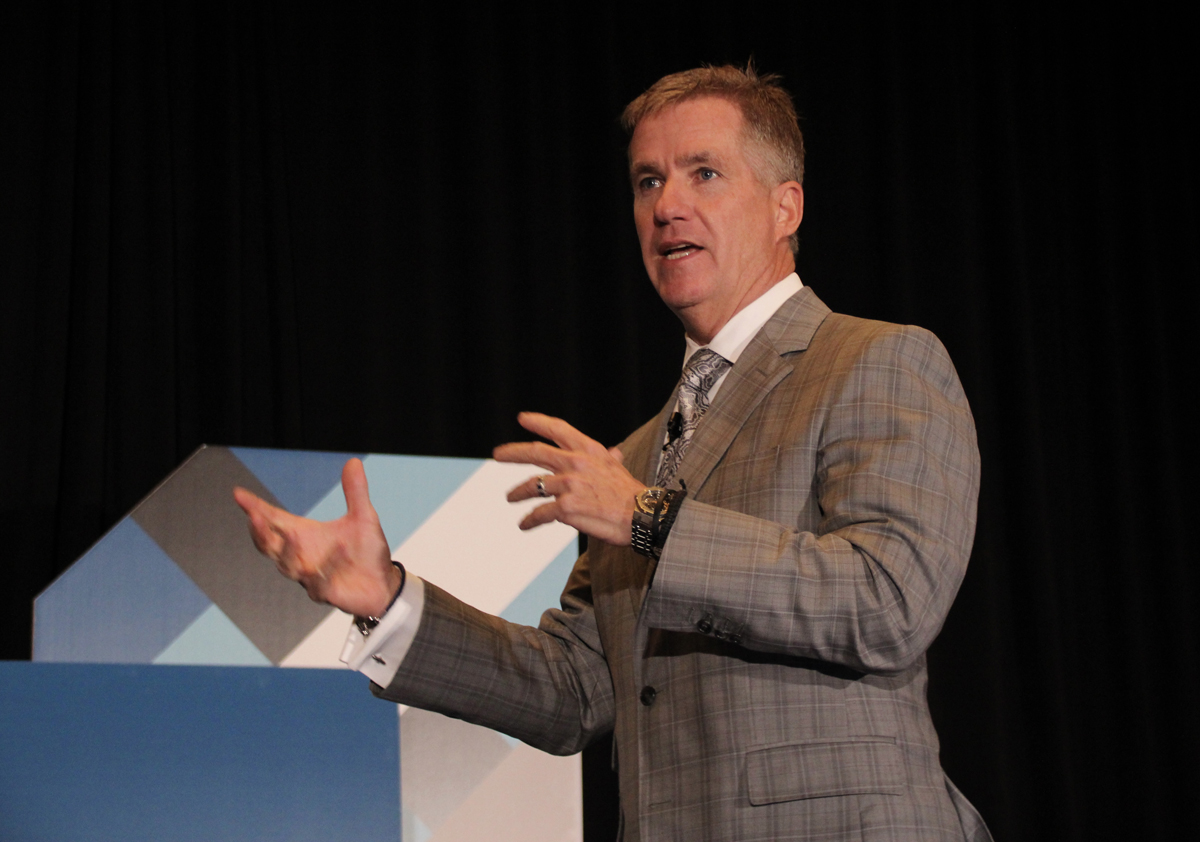
“I’m not drinking the merger Kool-Aid that this thing’s going to get approved. It may or it may not,” Creel told an investor conference on Wednesday.
“I believe, especially in light of the last ruling when their application was ruled incomplete, it says that … this isn’t a layup,” Creel says.
UP CEO Jim Vena has argued that the deal to create a transcontinental railroad is so good for shippers, the rail industry, and the country that it will be a regulatory slam dunk. The railroads will file a revised application on April 30.
The STB has said that the Jan. 16 rejection of the application as incomplete is not an indication of how the board may rule on the merger itself.
But Creel noted that the STB’s current merger review rules were drawn up in 2001 after the disruption caused by Class I railroad megamergers of the 1990s. The earlier regulations encouraged industry consolidation, while the new ones were written to pause and ultimately stop major mergers between the largest Class I systems, Creel contends.
“Those integrations were painful,” Creel said of Burlington Northern-Santa Fe, Union Pacific-Southern Pacific, and the CSX and Norfolk Southern split of Conrail.
Creel contends that those troubled merger integrations foreshadow what’s to come if the STB approves the UP-NS merger. “The risk factor — that’s huge,” Creel says, no matter how much planning goes into crucial steps like extending UP’s NetControl computer system to the NS network.
UP executives have promised a smooth computer system transition like the one they accomplished in 2024 when NetControl was activated.
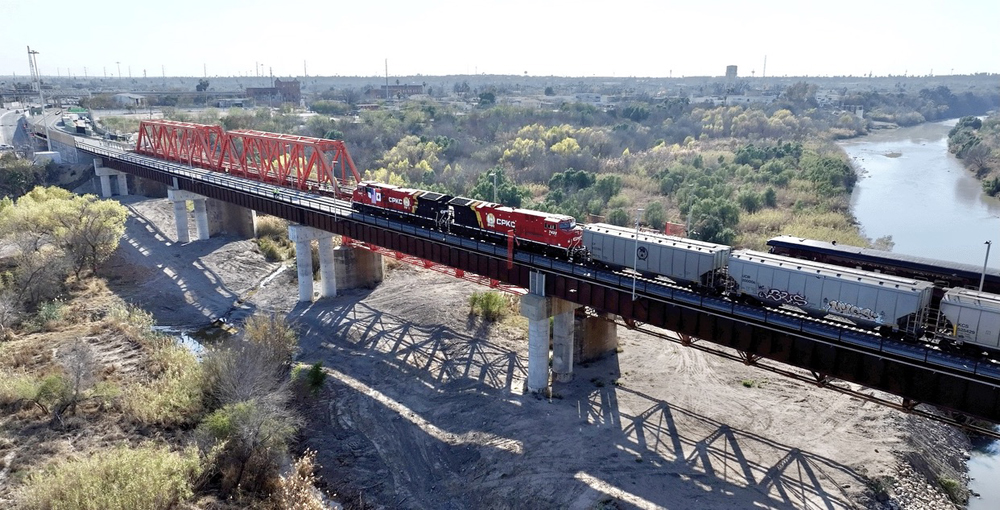
When CPKC shut down the legacy KCS computer system in the U.S. in favor of the CP system in May 2025, it promptly led to service problems on CPKC in the Gulf Coast.
“They’ve done a great job in cutting over their own system,” Creel says of UP. “But … replacing your own system with a system you designed, versus marrying another company and trying to integrate and cut over a system you uniquely do not know? There’s complexities that are involved that with the best of planning it’s impossible to get it all right,” Creel says, noting that no one fully understood things that were going on in the background that kept the KCS system working.
Creel also says a merger the size of UP-NS poses operational risks in and of itself. “Jim’s a good railroader, a good operating guy,” Creel says of Vena, a former Canadian National colleague. But even if the integration goes relatively smoothly, things like harsh weather in Chicago can quickly knock a railroad off kilter, Creel says.
“When it’s 40 below zero for an extended period of time, and you’re in the middle of Chicago and the snow falls, you have a problem,” he says.
While the UP-NS merger will take some cars out of the Belt Railway of Chicago’s Clearing Yard — the busiest classification facility in the Windy City — the expanded UP would still be the biggest user of the yard and will control almost half of the rail traffic in the U.S. Given that, Creel says that if UP stubs its toe, it will affect the entire rail network.
The primary argument behind the Canadian Pacific-Kansas City Southern merger — that CPKC’s end-to-end combination would be able to offer customers seamless, single-line service — also applies to UP-NS, Vena told an investor conference this week. Vena also said that the degree of overlap between the UP and NS systems is roughly the same as on the pre-merger CP and KCS networks.
“Some people would say, Keith, you’re a hypocrite. You’re a product of consolidation,” Creel says of the CP-KCS merger, which was judged under the STB’s old merger rules. “I’m not a hypocrite. I understand the facts. What we did complemented and created competition without tilting the scales of market power to the disadvantage of any particular customer. There’s not one single customer that lost an option with us. It truly was end to end.”
He also says CPKC didn’t have to offer shippers anything like Committed Gateway Pricing, which UP is offering to ensure gateway through rates are preserved for UP-CSX and NS-BNSF routings.
“And what was true about us is not true about this combination,” Creel says. “You’re talking about something that creates, if it’s approved, a Goliath that is going to have exponential market power.”
CPKC united the two smallest Class I lines — railroads that touched only at Kansas City, where they shared Knoche Yard for decades, Creel notes. CPKC is still the smallest Class I.
“The scale is the X factor. It’s uniquely different than what we did,” Creel says of UP-NS. “Again, Chicago is a great example. The bigger it gets, the more complicated it gets, and the more the pain if you get it wrong.”
CPKC has struggled to meet merger-related volume growth targets, partly due to ongoing trade tensions involving the U.S. and Canada and Mexico. And Creel questioned the UP-NS growth projections of taking 2 million trucks off the highway annually.
“To achieve them, you’re assuming that the trucking industry is just going to roll over. They’re not. I think we’ve learned that that’s a different beast to compete against,” Creel says.
Creel says consolidation in the rail industry is not necessary. But he also says that if UP-NS is approved, it will prompt additional mergers.
“It will definitely create an environment where it will be necessary for additional consolidation. Now I’m not speaking out of both sides of my mouth. I do not believe we need consolidation. I do not want consolidation,” Creel says. “But if it happens, then I think you’re going to have additional consolidation that is necessary and that is inevitable. And how it all shakes out, I’m not certain.”
Creel spoke at the Citi Global Tech and Mobility Conference on Wednesday. He made similar comments today at a Barclays conference.
— To report news or errors, contact trainsnewswire@firecrown.com.


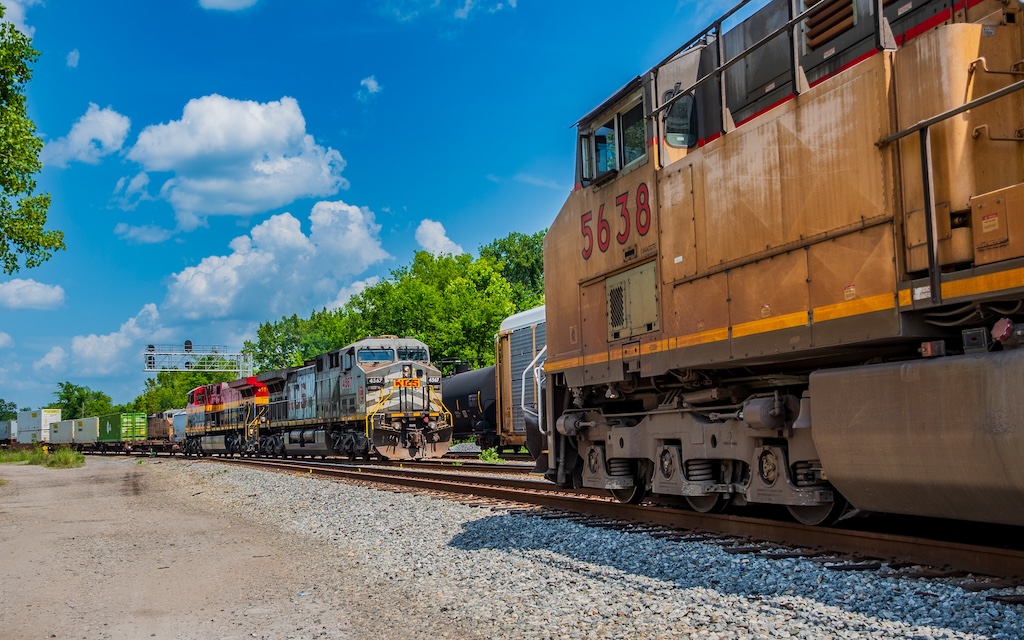
Is the picture mis labeled? It appears that the KCS locos are spaced behind a car carrier.
Forgot to mention that Meridian is one of the few places a 3-way or 4-way meet can be accomplished. Believe Jackson, MS is another. That will probably not enough locations if the buy-out goes thru. That will require at least 2 – 4 very long sidings.