





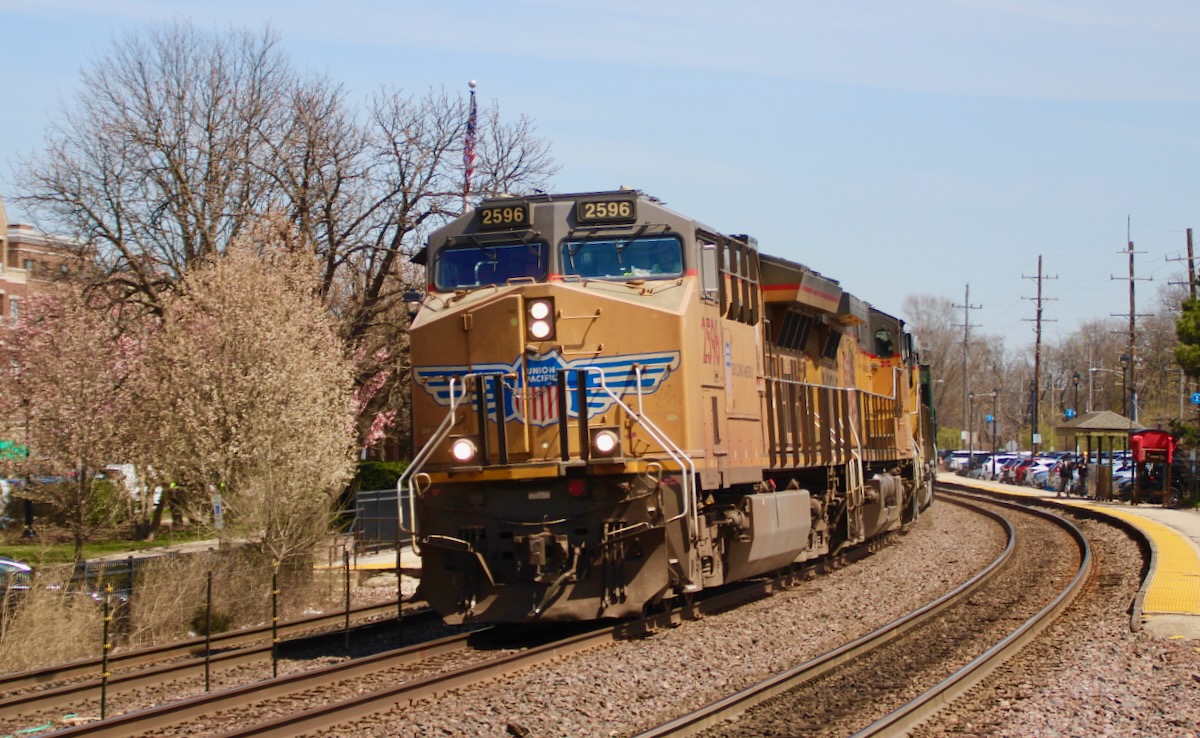
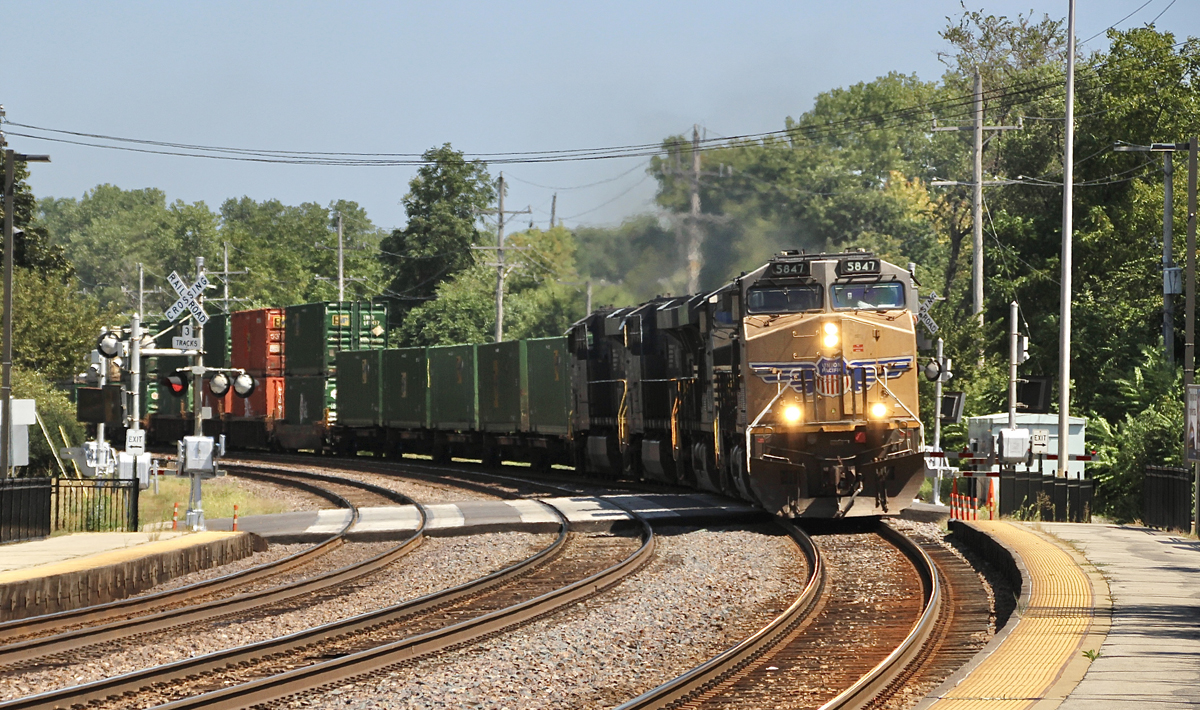
BERKELEY, Ill. — Seven suburban communities along Union Pacific’s east-west main line are organizing to pursue representation in the UP-Norfolk Southern merger proceedings.
A memorandum to the president and board of the Village of Berkeley in Cook County says the community was contacted by the other six communities — Elmhurst, Lombard, Glen Ellyn, Wheaton, and Winfield in DuPage County, and Geneva in Kane County — who expressed concern about the increased train traffic that could result from the merger and its impact on emergency services.
According to the memo, the UP-NS merger application indicates the route, already served daily by approximately 50 freight trains and 59 weekday Metra UP West Line trains, will see an additional four freight trains per day.
“Together, we are combining efforts and resources to present a unified opposition to this merger, or at least have a dialogue with UP to discuss the impacts to our communities,” says the memo from Rudy Espiritu, Berkeley village administrator.
The group, the Western Chicagoland Merger Oversight Alliance, will share equally in the costs of employing Washington lawyer Tom W. Wilcox to represent it in Surface Transportation Board proceedings, up to a cost of $50,000. If additional funding or actions are required, the alliance would consider a formal intergovernmental agreement.
A memo to Geneva’s city council, which approved taking part at its Jan. 20 meeting, said the goal of the alliance “is not to attempt to stop the merger, but rather ensure our respective communities are represented in the process.”
There is precedent for communities and groups of municipalities in the Chicago area taking part in STB proceedings, although they have experienced mixed success in shaping transactions.
As part of its 2008 approval of Canadian National’s purchase of the Elgin, Joliet & Eastern — which experienced significant opposition from communites along the EJ&E — the STB required CN to cover the majority of costs in grade-crossing separation projects in Lynwood and Aurora, Ill. Other measures included cameras to monitor grade crossings to aid first responders, school and pedestrian safety measures, and noise reduction projects. CN appealed the grade-crossing requirement, but it was upheld in court.
Another group of eight communities opposed the Canadian Pacific-Kansas City Southern merger over the impacts of that merger’s projected increase in freight traffic from three to 11 trains per day on the route also used by Metra’s Milwaukee West service. “The Coalition to Stop CPKC” initially sought a long list of projects to mitigate the impact of the merger [see “Chicago suburbs seek $9.5 billion …,” Trains.com, March 1, 2022].
While the group later moderated those requests, the STB’s then-chairman, Martin J. Oberman, said the initial request was “not the real world and it’s not going to happen” at a press conference announcing approval of the merger [see “Metra, Chicago suburbs see few concerns addressed …,” March 15, 2023]. The board said its seven years of oversight would allow it to require further mitigation if it proved necessary. The coalition sued, seeking reconsideration by the STB, but the suit was dismissed last year [see “Federal court rejects Chicago suburbs’ bid …,” June 20, 2025].
— To report news or errors, contact trainsnewswire@firecrown.com.


50 freight trains per day? I think not. More like 25 to 30. This group should start by getting their facts straight!
The precedent was set with the EJ&E merger. This is just another example of a government shake down for money. For Shame!
Current 109 trains per day and a possible increase of 4, that would be 3.6% increase. I would think there would be better ways to spend taxpayer dollars.
Anybody who lives anywhere can express an opinion or a concern, or else join with others who see themselves as stakeholders so as to articulate their needs as a wider group. What can’t happen is to give these communities veto power as if they own the tracks through their cities or villages. The tracks were there first. People chose to buy homes and build communities alongside the r/w’s later.
The City of Cleveland (Ohio) mucked up the Conrail split into NS and CSX lines, claiming impact onto low-income minority neighborhoods. I would hope that middle-income and higher-income communities in the suburbs west of Chicago will act responsibly.