

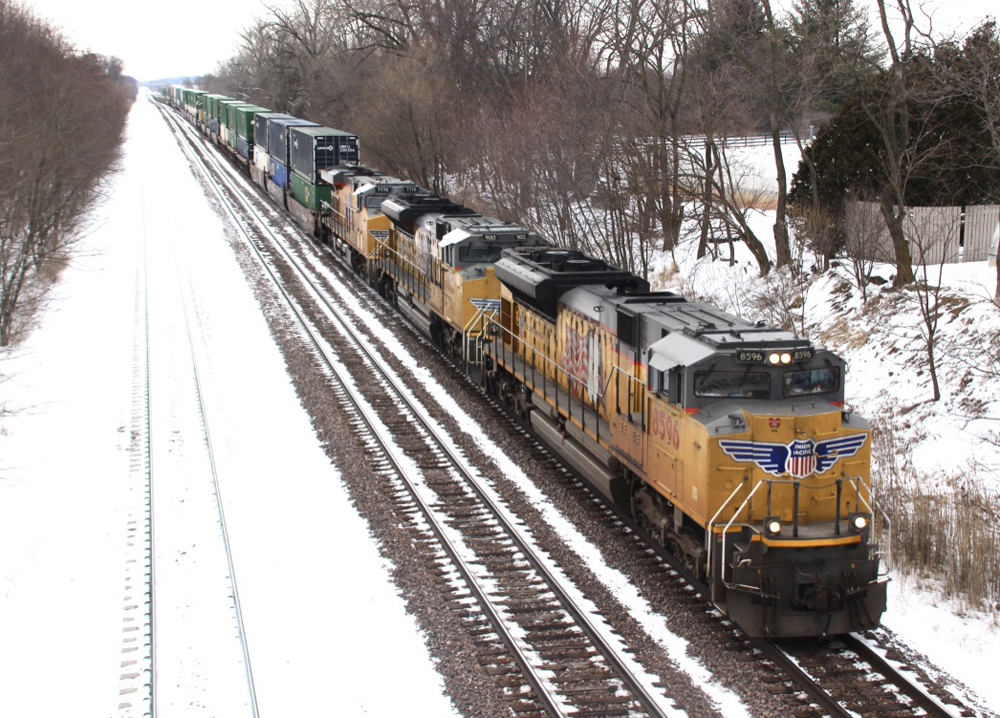
WASHINGTON — The Union Pacific-Norfolk Southern merger application omits $2.69 billion in additional costs that intermodal marketers will incur if the railroads’ deal diverts the promised 2 million loads off the highway, according to an analysis submitted to federal regulators.
The railroads’ traffic diversion projection is a key part of their case that the merger would enhance competition, as required under the Surface Transportation Board’s merger review rules. The railroads’ 6,692-page application filed on Dec. 19 projected that within three years the expanded UP would move 1.4 million additional intermodal loads and 425,000 carloads.
“While UP-NS offered plans for the operations on their combined railroad, no such plan was offered for their prospective IMC (intermodal marketing company) partners,” said the filing by Drew Robertson, a consultant who has worked on prior mergers and is president of Atlantic Systems Inc. “The application as it stands does not indicate whether the IMCs as a group have the capital, operational capability, or the willingness to expand.”
Union Pacific committed to spending $2.1 billion in improvements, including $1 billion for capital spending for track, yard, and intermodal terminal upgrades, and $1.1 billion for technology integration and other investments.
Intermodal analyst Larry Gross says the analysis underpinning the UP and NS growth projections is solid. “Their methodology looks very thorough, very sound,” he says.
But Gross also said it was hard to believe the merged railroad could boost its domestic intermodal volume by 31% over three years, since their combined intermodal volume has been relatively flat since 2014.
In the years after NS and CSX divided Conrail, both railroads increased their intermodal volumes — eventually — after merger-related service problems were smoothed out.
“‘Build it and they will come’ works in Hollywood movies but not for multi-billion-dollar business investments,” Robertson said.
He named Hub Group, J.B. Hunt, and STG Logistics as intermodal marketing companies that would have to step in to provide the additional needed containers, tractors, chassis, and terminal services to a coast-to-coast UP.
Robertson’s filing was made three days before the STB rejected the UP-NS application as incomplete. The railroads say they will provide regulators with the additional information they requested in their Jan. 16 decision.
Robertson’s $2.69 billion added cost estimate includes $1.14 billion to buy 120,000 containers and $900 million to acquire 5,000 electric or clean diesel tractors. Acquiring 100,000 more chassis would add $500 million. Terminal and information technology costs would account for the remaining $100 million.
His filing also said the application lacked an accounting or economic study of the impact on intermodal marketers, as well as any comments from them.
The filing also notes the financial consequences, saying “prospective IMC partners must offer detailed testimony from the financially solvent IMCs demonstrating their ability and indeed willingness to invest billions in new equipment and operations.”
Earlier this month, STG Logistics made a bankruptcy filing and announced a restructuring agreement.
Robertson also noted that the merger application didn’t include the environmental impact of shifting a million-plus loads to intermodal. That shift would affect air quality and noise by concentrating the added volume in urban areas with a handful of terminals.
The UP-NS application also projects diversion of intermodal moves from competitors because the merged company’s single-line service would be faster and more efficient than intermodal moves involving multiple railroads.
Gross observed that “no one will notice” a 2 million load diversion in the broader freight market because roughly 190 million truckloads are moved more than 300 miles annually.
Gross also questioned one aspect of the intermodal plan, which calls for linking origins and destinations with as few as 12 daily containers, or just two or three well cars’ worth of volume. Such small volume is inconsistent with Precision Scheduled Railroading principles, which focus on moving large volumes long distances, he says.
Such a small number of cars would complicate operations and require en route switching, block swapping, or container sorting that slow service and add cost, Gross explained.
— To report news or errors, contact trainsnewswire@firecrown.com.
Share this article