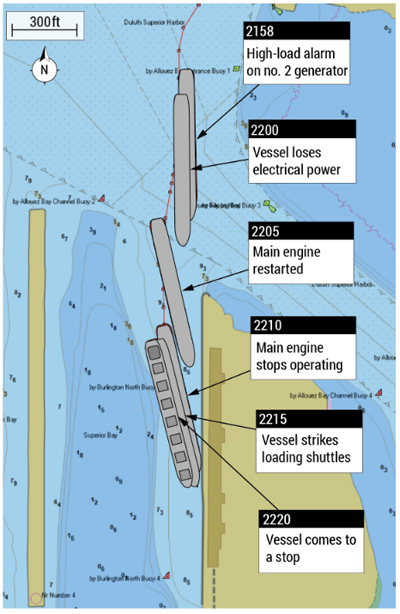
Administration Electronic Navigation Chart US5DLHCG
as viewed on MadeSmart automatic identification
system.
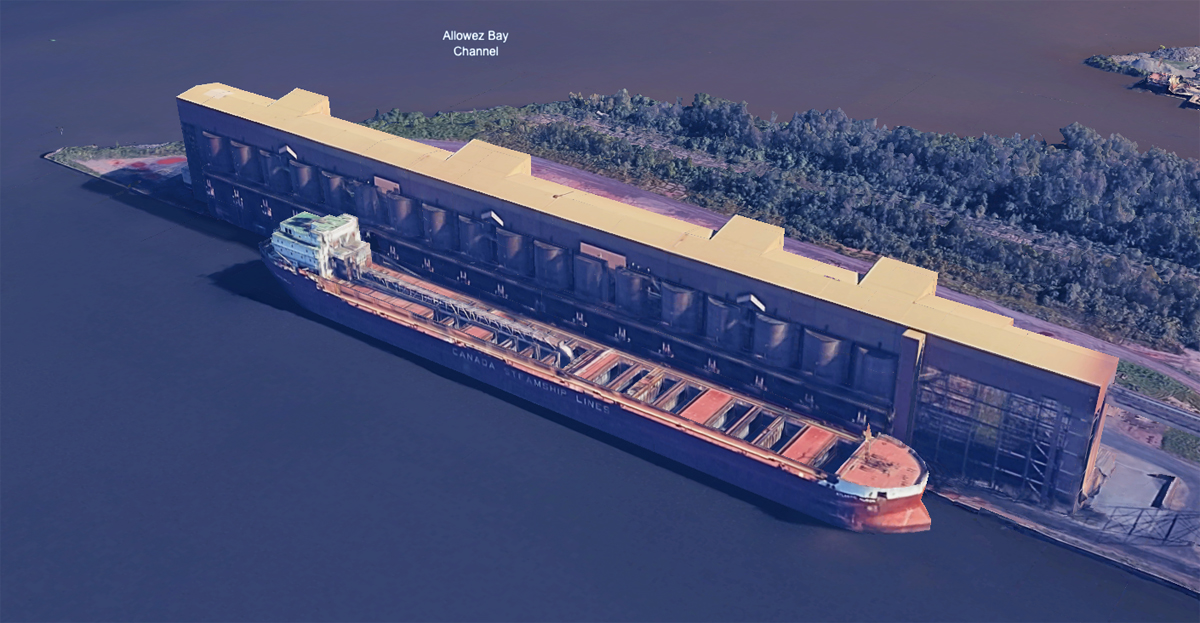
WASHINGTON — Loss of electrical power and propulsion because of generator issues, and a failure to fully address earlier electrical problems, led a ship to collide with a BNSF taconite loading facility, the National Transportation Safety Board said in its final report on the July 24, 2024, incident in Superior, Wis.
The collision damaged five of the loading shuttles at the Allouez Taconite Facility, with damage estimated at $950,000 while the bulk-load cargo vessel Algoma Discovery sustained some $130,000 in damage. No one was injured.
The ship had been experiencing electrical problems en route to Superior, but the chief engineer was able to restore all three of the ship’s generators to operation while the Algoma Discovery was at anchor off Superior waiting to load. But while en route to the dock, the ship lost all generator power after engaging its bow thruster; the main engine was quickly restarted, but shut down again five minutes later. Two anchors were deployed, but the ship still struck the dock at a speed of about 0.9 knots.
The NTSB determined the probable cause of the accident was the chief engineer and operating company not sufficiently evaluating and repairing the previously online generator problem. The report says such electrical components should be tested to full capacity, or as close to full capacity as possible, to ensure they can meet demand during maneuvering. If the problem cannot be completely resolved, alternate measures such as the use of tugboats should be considered.
— To report news or errors, contact trainsnewswire@firecrown.com.
Share this article