Railroads proposing mergers inevitably make ambitious promises and projections, particularly about faster service and more competition. Not all of them become reality, despite the best intentions of railroaders who work at a feverish pace to develop the operating plans submitted to federal regulators.
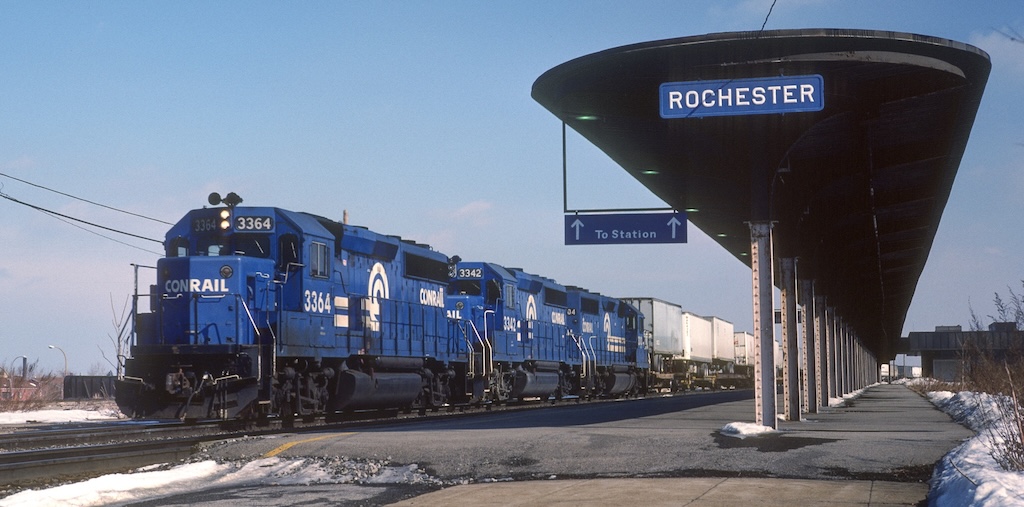
A case in point: CSX, as part of its 1999 acquisition of 42% of Conrail, said it would trim the schedules of its Chicago-New Jersey premium intermodal trains in order to become more competitive with trucks.
The railroad wanted to turn back the clock and nearly match the 24-hour schedules that the New York Central and Pennsylvania railroads offered three decades earlier. Conrail’s TrailVan trains averaged 30 to 32 hours between Chicago and the New York area due to the operation of longer trains, strict adherence to speed limits, and the concentration of traffic on fewer main lines.
CSX told regulators that four of its 12 planned Chicago-New Jersey intermodal trains would operate on 26½- to 28-hour schedules. To accomplish this, CSX said it would allow intermodal trains to run at 70 mph between Chicago and Selkirk, N.Y., up from 60 mph.
“When completed, CSX will have a quality, 70 mph line from Chicago to New York, which is essential for CSX to be competitive for the large volumes of traffic that will traverse that route,” CSX told the Surface Transportation Board. In the only sentence underlined in its operating plan, CSX said it would offer “intermodal service that will be two and one-half hours faster than the best service Conrail can offer today.”
Yet this never happened. CSX later said it couldn’t justify the extra fuel expense of running 70 mph, but was open to offering expedited schedules if there was demand for them.
Not to be outdone, Norfolk Southern also said it would reduce the schedules to 26 to 28 hours for four of its 17 planned Chicago-New Jersey intermodal trains once it began operating its 58% share of Conrail.
These hotshots would not run via what it then called the Penn Route, a combination of the former Lehigh Valley, Reading, Pennsylvania, and New York Central main lines. Rather, NS planned to send them over Conrail’s lightly trafficked Southern Tier route from New Jersey to Buffalo, then over its former Nickel Plate main from Buffalo to Cleveland, and from there over the former New York Central to Chicago.
Conrail sporadically ran intermodal trains over the Southern Tier, but on schedules 3 hours slower than the Water Level Route between New Jersey and Buffalo. NS told regulators it would beef up the Southern Tier and boost track speeds to 60 mph from 50 mph.
You can put this in the Never Happened file, too. NS found that upgrading the Southern Tier — which still sported semaphores in some areas, along with stretches of jointed rail and spring switches on passing sidings east of Binghamton, N.Y. — would be an expensive proposition. Plus, NS wound up having ample capacity on the former Pennsy.

When Union Pacific sought to acquire Southern Pacific in 1996, as the natural response to the Burlington Northern-Santa Fe merger of a year earlier, UP and BNSF drew up a massive agreement covering trackage rights and competitive access to customers at locations served by both UP and SP. UP and BNSF officials assured the STB that BNSF’s 3,968 miles of trackage rights over UP-SP and UP’s 376 miles of rights over BNSF would guarantee vigorous rate and service competition.
Instead, the trackage rights have proven to be a flop, aside from routes to Mexican gateways. BNSF no longer uses UP-SP routes as a shortcut from the Gulf Coast to Memphis. And its trackage rights over the Central Corridor between Denver and Northern California, which a lowly merchandise train uses two or three times per week, offers only token competition.

It’s a relevant lesson today. UP and NS are asking regulators to approve a merger backed by ambitious service and competition claims that echo those of prior Class I railroad combinations. The critical question is not whether railroaders believe in their operating plans, but if those plans will survive a collision with reality, changing circumstances, and ongoing cost pressures.
You can reach Bill Stephens at bill.stephens@firecrown.com and follow him on LinkedIn and X @bybillstephens
— To report news or errors, contact trainsnewswire@firecrown.com.

So Bill, what about BN-Santa Fe? I would say not bad under the leadership of Rob Krebs. Two legendary franchises that together became one Super Franchise. And when Rob got tired of David Goode repeatedly turning him down, he got CN and Paul Tellier to agree to the “Mother of ALL Mergers”, which was so awesome it scared that crap out every other Class One on the North American continent. It also showed up Linda Morgan and the rest of the nitwits at the STB.
Then you create the trifecta of JB Hunt, Berkshire Hathaway and the Family Perot….as I have written in Classic Trains, they were both LUCKY and GOOD.
To speed up schedules you don’t need to run at 70MPH. You need to increase average speed. A few things need to happen.. Ample capacity to overtake slower traffic, reduce the number of crew changes, eliminate slow orders, straighten some curves and higher speed turnouts at control points.. ECP would be a great average speed multiplier, moving block get rid of fixed blocks…It’s pretty pathetic, one of the new Z trains UP, is proposing in its merger application has 20 crew changes…. Can we get 400mi out of a crew?….
The post 1990 mergers have been about building fortress monoploies and financial returns for hedgies and executives. Competition and reliable service is that last thing these monsters want. The class 1 operating margins of 40%, lack of capital investment and asset stripping says it all.
Agreed. Conrail was a great railroad that should never have been split up. UP-SP was an unmitigated disaster. CP is in the process of ruining the once-great KCS. This proposed merger will fare no better. I don’t believe the new merger rules will allow it (unless someone is paid off), and that’s a good thing,