





OMAHA, Neb. — While the end-to-end nature of Union Pacific-Norfolk Southern merger limits the amount of redundant trackage or facilities, the railroads do have some duplication of facilities at their current interchange gateways.
The merger application submitted to the Surface Transportation Board on Dec. 19 calls for two intermodal terminals and two auto processing facilities in those major gateways to be idled, along with changed or reduced roles for five other yards. One yard outside of the gateway cities will also be idled.
The merger “will increase the combined railroad’s ability to shift traffic between terminals,” the application says, “particularly in critical locations where UP and NS each have their own terminals today, including Chicago, Kansas City, and New Orleans.”
Here are the plans outlined in the application.
Chicago
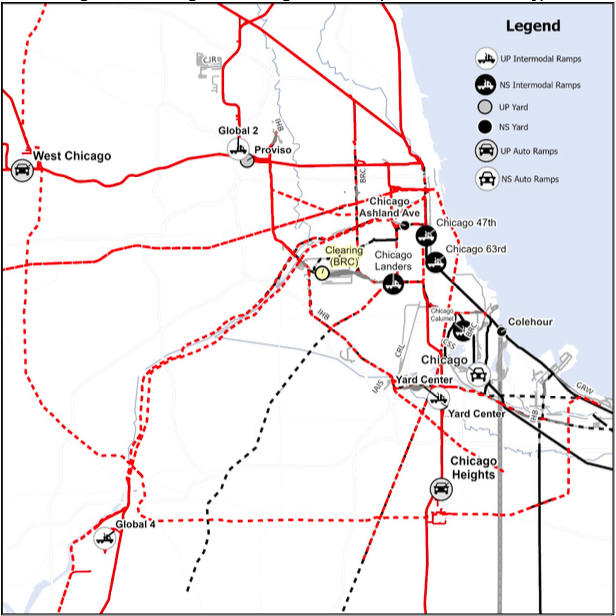
The plan calls for idling two current intermodal facilities, leaving five major facilities in the Chicago area. Traffic at UP’s Yard Center intermodal terminal in Dolton, Ill., will be shifted to NS’ 47th Street terminal; volume at NS’ 63rd Street terminal will be consolidated into UP’s Global 2 facility. Global 2 and 47th Street are projected to see increases of 371 and 229 lifts per day, respectively. UP’s Global 4 facility is the only one of the five projected to see a significant decrease — 226 per day — because of train plans that will eliminate some UP-NS interchanges at the Chicago gateway. UP’s Chicago Heights automotive facility will consolidated into the Norfolk Southern facility at Hegewisch.
Yards for manifest freight will retain their same basic functions, the application says, but car handlings will decrease through blocking plans that will allow trains to move through gateways without interchanging. UP and NS say the Belt Railway of Chicago and Indiana Harbor Belt will continue to handle traffic interchanged with other Class I railroads, but that the merger will decrease BRC handling of traffic between UP and NS by about 200 cars per day.
St. Louis
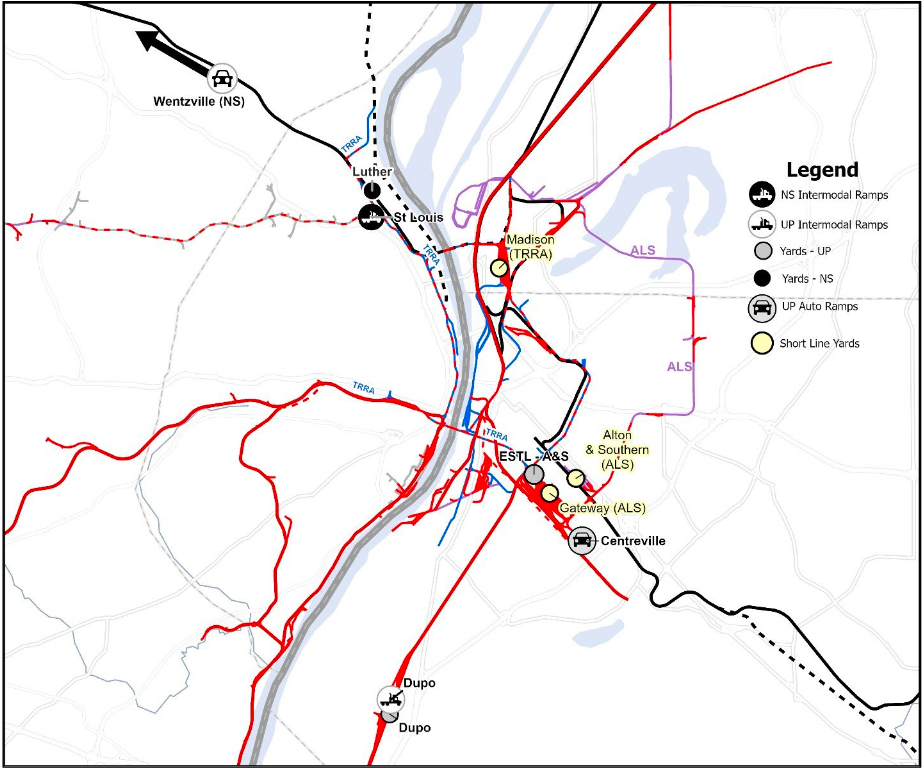
Through traffic handled at Norfolk Southern’s Luther Yard will be shifted to Alton & Southern’s Gateway Yard, but Luther will continue to serve as an intermodal terminal and to handle manifest traffic for local NS customers. As in Chicago, the railroads say blocking of traffic elsewhere will decrease classification work for the Alton & Southern, while using the Alton & Southern to build blocks of eastbound traffic will eliminate the need for the A&S to transfer some traffic to the Terminal Railroad Association of St. Louis.
Automotive traffic that currently goes to a Norfolk Southern facility in Wentzville, Mo., will instead go to UP’s Centreville facility.
Kansas City
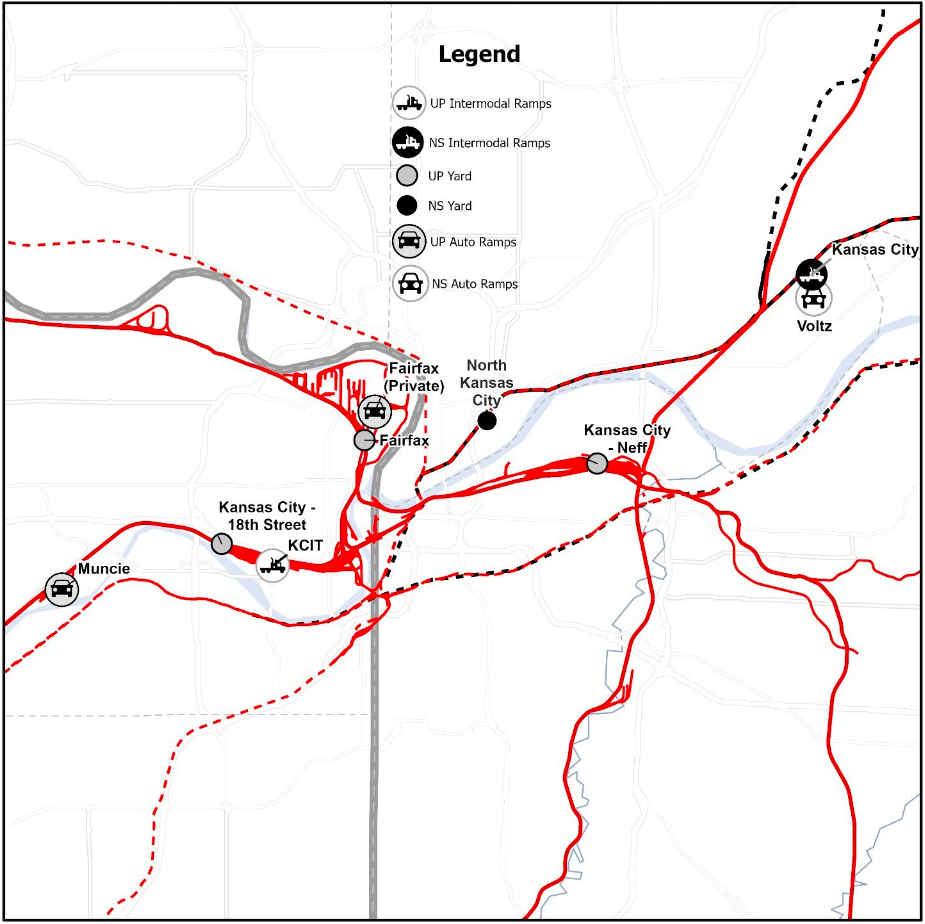
Manifest traffic currently handled at NS’ North Kansas City Yard will instead go to UP’s 18th Street Yard. North Kansas City will continue to be used for local trains, with traffic shuttled between the two yards. Existing intermodal facilities — UP’s Kansas City Intermodal Terminal and NS’ Voltz Yard — will primarily be used to separate domestic and international intermodal traffic. Voltz will also be used for traffic between Southern California and the Lower Ohio Valley as part of the creation of a new intermodal route between those areas, and will receive pre-blocked auto traffic destined for Mira Loma, Calif. UP’s Muncie Automotive Facility will be idled, with that traffic moving to Voltz; the application says this will “reduce congestion on the west side of the Kansas City complex.”
Memphis
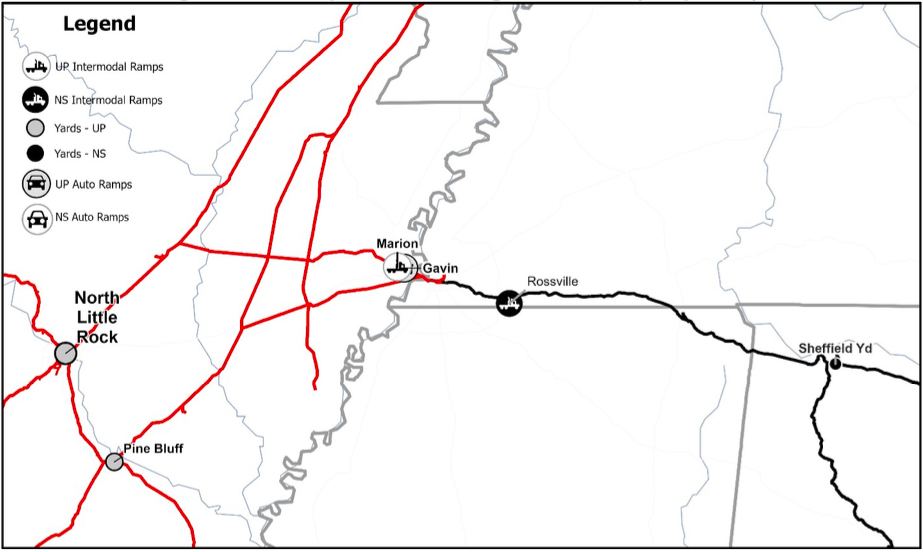
The application says the combined railroad will “rebalance” intermodal operations between NS’ Rossville Yard and UP’s Marion Intermodal Terminal; the UP facility has the capacity to handle additional traffic. A local train that currently originates at Rossville will instead start at either UP’s Sargent Yard or NS’ Sheffield Yard.
New Orleans
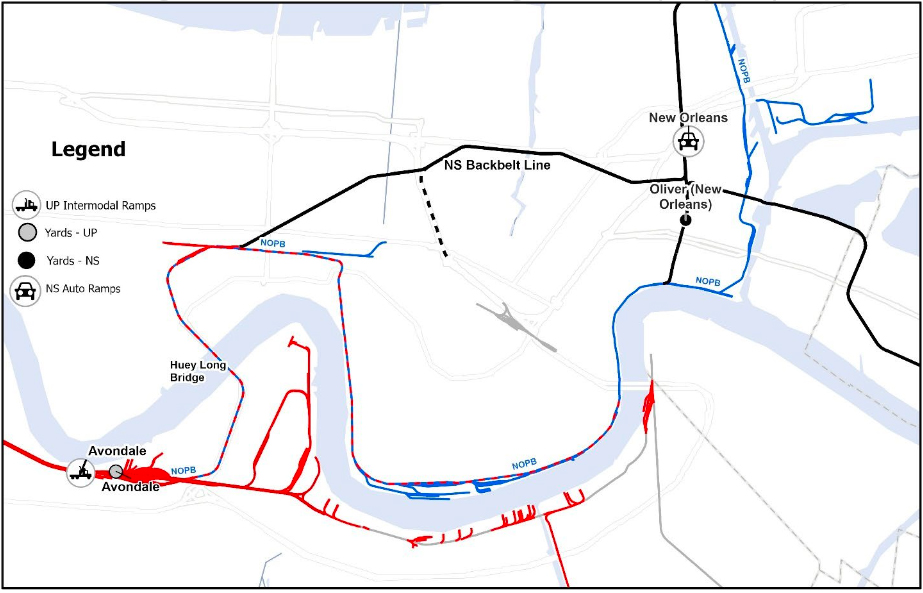
Some traffic currently handled at NS’ Oliver Yard — notably interchange traffic for BNSF — will be shifted to UP’s Avondale Yard. This will ease congestion on NS’ Back Belt Line, which currently sees four UP-NS interchange trains daily, as well as BNSF-NS interchange. Oliver will continue to be used for interchange with CN, CPKC, and New Orleans Public Belt, although the CN and CPKC could eventually be shifted through Livonia to Baton Rouge, La.
Other changes
Norfolk Southern’s Glake Yard in Des Moines, Iowa — an interchange facility not connected to any NS main line, reached by BNSF trackage rights — will be idled. Its traffic will be moved to UP’s Shortline Yard, also in Des Moines.
The merger plan also calls for Union Pacific to expand its use of remote-control locomotives and a technology called SwitchPro eNtry eXit, or NX, into some Norfolk Southern terminals. It says this will eliminate the need for yard conductors to manually line switches, allowing single-person yard classification. It estimates an annual savings of $20.4 million as a result. It expects to save another $5.2 million through expanded use of a computer program, Terminal Command Center, that it says allowed it to reduce the number of yard controllers on the UP system.
— To report news or errors, contact trainsnewswire@firecrown.com.


Thanks to Trains for including maps so we can follow along.
Before I even got to the past paragraph, I said to myself that UP+NS would idle the isolated Glake yard on Des Moines’s southeast side. I believe it’s on former CB&Q land, as the actual ex-Wabash yard is further in town at SE 18th street, which happens to be a stone’s throw from Short Line yard. Before the mid-90s, when it was torn up, NS, and the Wabash before it, had a bustling business in & out of Des Moines, based out of Union Yard south of downtown. Further back, when Lake Red Rock was southeast of town was being planned, large portions of the Wabash trackage were going to be under water, so a joint Wabash-BN line from Albia to Des Moines was formed- it used a BN (ex-CB&Q) branch from Albia through Knoxville, then it turned north off of that line at Swan, crossed the river on a new, high bridge built with concrete pillars and deck plate girder spans, then followed the ex-Wabash from Runnells into town. In order to reach Glake yard, the line makes 2 sharp turns basically on an S-curve to bridge the one mile gap between the ex-Wabash alignment and the ex-Burlington one on which Glake yard was built. I’m surprised NS held on to the business as long as it did. I wonder if BNSF will take over?
I imagine they could buy it if they wanted it or UP could trade it to BNSF for something UP needs somewhere else.
Chicago is the only city here I know well enough make a specific judgement on but it seems that everywhere there is redirection of intermodal terminal work there could be local truck traffic impacts. There also could be changes in number of trains at grade crossings.
Does the proposal address these issues or will UP-NS just wait to see if local political pressure arrises? As an example I am thinking of the tussle that developed between the CN and some of Chicago’s western suburbs after they merged with the EJ&E.