





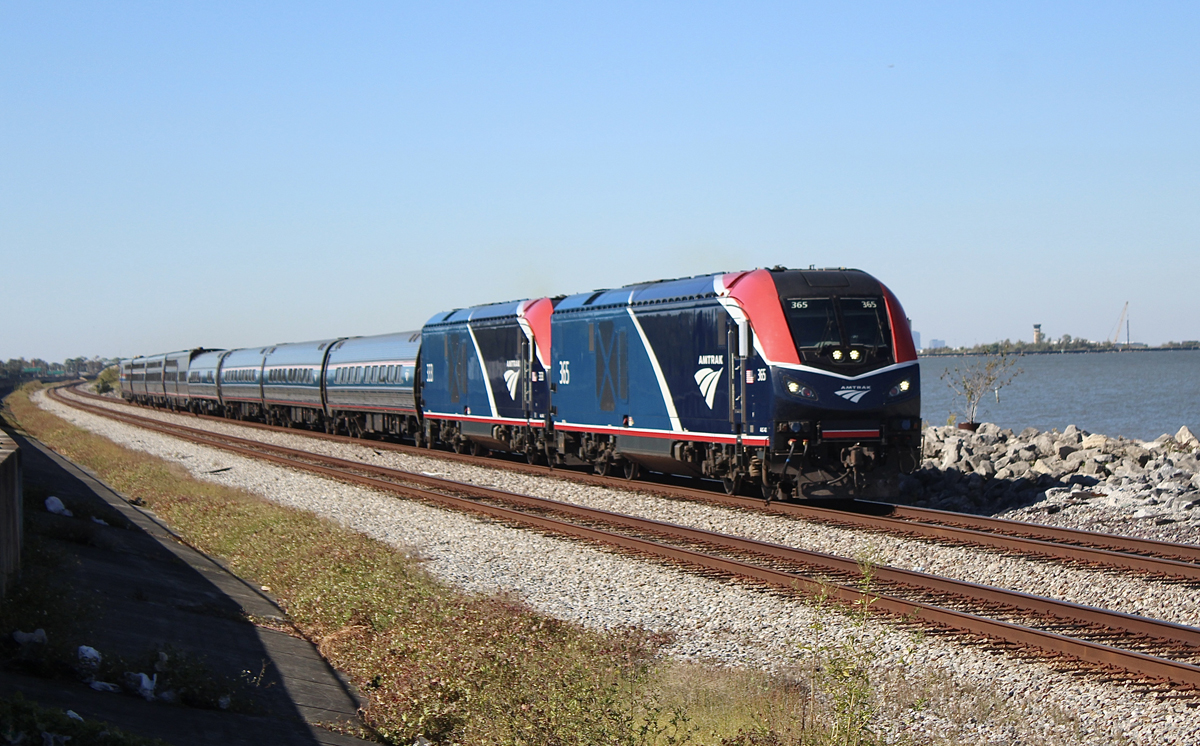
WASHINGTON — The Union Pacific-Norfolk Southern merger application filed with the Surface Transportation Board on Friday attempts to explain away adverse effects on passenger trains by vague promises of future “targeted infrastructure enhancements,” but generally doesn’t outline what those might be. In one case, a combined UP-NS proposes adding nine daily freights to a single-track route.
Following a series of maps explaining the creation of cross-country intermodal trains to bypass time-consuming terminal interchanges, a section of the massive filing addresses “Impacts on Passenger Operations.” (This begins on page 637 in Vol. 2 of the four-volume filing.) It begins with a patently false statement: “The UP/NS merger will not result in any adverse impact to passenger operations.”
That would only be true if the merged railroad promises to coordinate the new expedited intermodal moves with passenger train schedules, present and future. Instead, a review of each passenger route currently operated by either UP or Norfolk Southern is accompanied by the caveat that the merged system would “ensure compliance with existing passenger obligations.”
Choke points
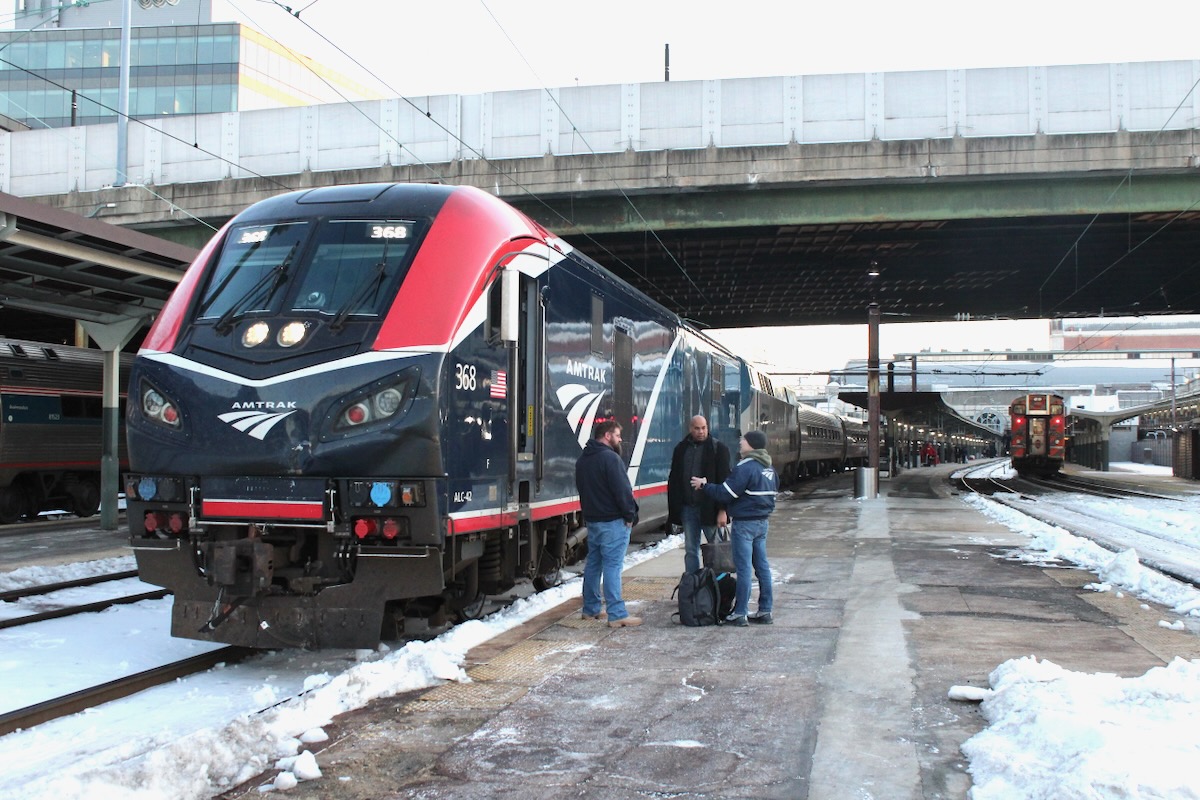
While many routes would be affected by one or two more daily trains and some would see a decrease, the New York-New Orleans Crescent and the New Orleans-Los Angeles Sunset Limited appear to take big hits. The Crescent already has had its schedule lengthened at Norfolk Southern’s insistence without the new additions, purportedly to improve punctuality, but it suffers from a near-midnight Atlanta northbound departure that kills the train’s potential to carry Northeast travelers overnight. With stepped-up intermodal departures under the merger, the Crescent will face:
— Manassas-Lynchburg, Va.: two to three additional trains.
— Greensboro-Charlotte, N.C.: two to three additional trains (Eight Piedmonts share these tracks).
— Atlanta-Meridian, Miss.: nine to 10 additional trains.
— Meridian-New Orleans: three to four additional trains.
Much of the route between Atlanta and Meridian is a hilly, single-track railroad, with the added complication that major junctions at those endpoints are dispatched by either CSX or CPKC. The UP-NS filing does indicate that eight passing sidings are to be extended between Atlanta and New Orleans, along with a section of second main at the north end of Meridian. That would help mitigate the impact of nine more intermodal trains. but this also the portion of the single-track route where the two daily passenger trains have to meet.
What about the Speedway?
Not acknowledged in the UP-NS filing is the Southern Rail Commission’s ongoing Corridor ID grant which studies extending a section of the Crescent from Meridian to Shreveport, La., on the joint CPKC-NS “Meridian Speedway;” Union Pacific from Shreveport to Marshall, Texas; then on the UP’s Texas Eagle route to Dallas.
The CPKC, as part of its successful merger application in 2021, said it would support passenger service on the Speedway. Judging from the numbers on both sides of Meridian, it appears that about six new intermodal trains will connect existing NS and UP lines between Meridian and Shreveport. The impact of these trains on the proposed passenger expansion across the Atlanta-Dallas I-20 corridor was not addressed, possibly because the merger’s sponsors assume any passenger expansion is off the table.
A daily Sunset Limited?
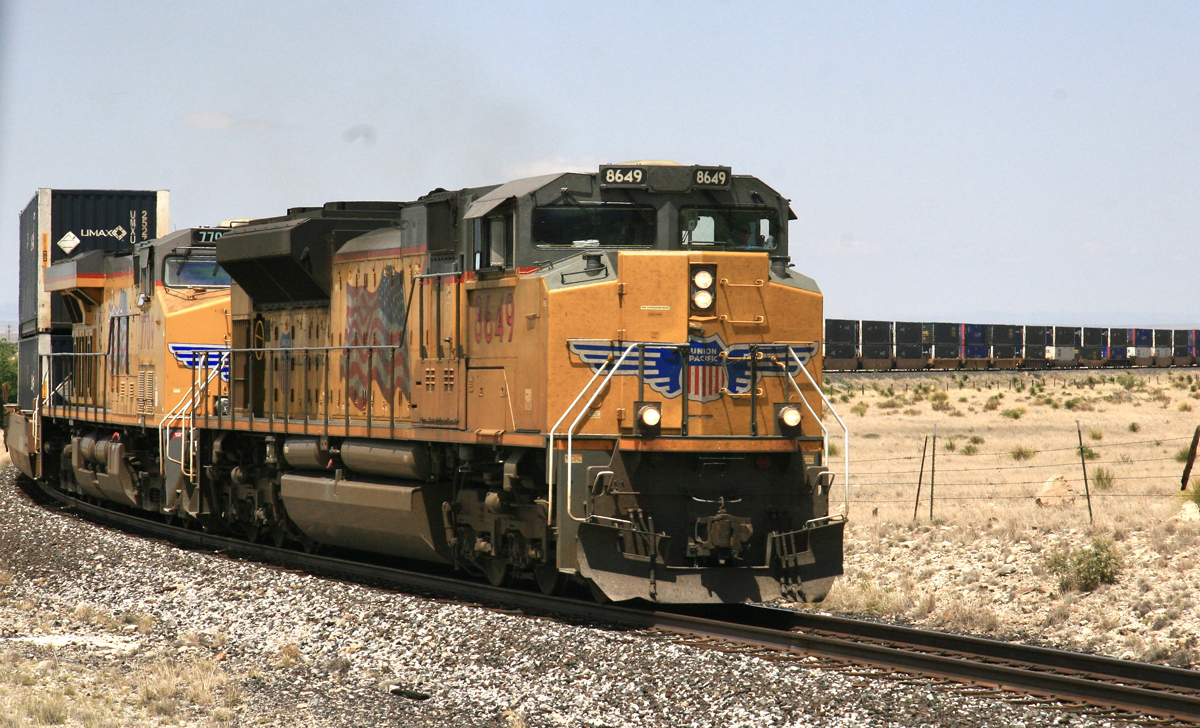
The proposal for a long-sought daily New Orleans-Los Angeles Sunset Limited was also not referenced. Depending upon the segment, the filing indicates the triweekly train will face two to six additional trains. The most additional traffic is on approximately 800 miles between West Colton, Calif., and El Paso, Texas, much of which UP has already double tracked.
In 2012, the railroad told then-Amtrak President Joseph Boardman that the company would have to pay $750 million for a daily Sunset without fully explaining why trains could run on time some days but not others without the improvements. During service challenges following the Southern Pacific merger in 1996 and from 2003 to 2005, the train suffered long delays in the Houston-Beaumont area.
History’s lessons
Rail Passengers Association President and CEO Jim Mathews was blunt in his preliminary assessment posted on RPA’s website.
“These assurances [that Amtrak trains won’t be impacted] come from two companies with well-documented histories of noncompliance with passenger on-time performance requirements, raising legitimate questions about enforceability,” Mathews wrote. “In short, the transaction appears designed to protect existing obligations rather than advance passenger rail expansion, leaving passengers and the public with limited upside and significant execution risk.”
When additional passenger train frequencies are proposed on any given route, the railroads almost always demand capacity improvements that would keep existing and future freight flowing. This is how Norfolk Southern was able to extract a state and federally financed infrastructure package for a second Harrisburg-Pittsburgh Pennsylvanian round trip, even though two passenger trains routinely traversed the multi-track thoroughfare each way for most of the Amtrak era.
Passing tracks were also added on NS’s busy Chicago-Porter, Ind., segment after a big meltdown there in 2016, but the railroad hasn’t allowed any more Michigan or Chicago-Cleveland Amtrak frequencies. Now it wants to field one or two more daily freights and says passenger trains won’t be affected.
Applying this reasoning, the Surface Transportation Board or transportation advocates might suggest that more intermodal trains would require specific improvements designed to protect existing and future passenger service. For the Sunset in particular, this would mean daily service and restoration of a route through and west of Phoenix as a condition of approving the transaction, since improving the train’s financial performance is in the public’s interest. If UP and NS wants more trains, shouldn’t they have to mitigate the impact on Amtrak and other operators?
— Updated Dec. 20 at 7 p.m. CT to add information on planned Atlanta-New Orleans capacity improvements. To report news or errors, contact trainsnewswire@firecrown.com.


Not new traffic just rerouted traffic and longer trains that will definitely interfere with existing and any future Amtrak operations.
So which is it, folks? Some people posting on these pages don’t at all believe the merger would mean more freight traffic.
But if there is more freight traffic, some people posting on these pages are concerned that the increase in freight trains would hurt passenger schedules.
Not sure if the “some people” in the first statement are the same as the “some people” in the second statement. It seems to me that the merger should increase freight traffic, but that serious conditions need to be in place to protect passenger operators, as well as to promote competition. Given UP’s history, conditions need to be very clearly worded with no “wiggle room”.
I have not read the application, but does UP intend to route Chicago-Kansas City freight via the former Alton (Joliet-Springfield) and Wabash (Springfield-Kansas City)? If so, the Lincoln Service could be at risk, after the state of Illinois spent lots of $ to upgrade it.
This region of Illinois and Missouri is also where competition is at risk.
Landon — If the mergers go viral, the conventional wisdom has been UP-NS-CP (now CPKC) and BNSF-CSX-CNR. My point? My point is that CPCKC must have noticed by now they need a direct route from Detroit to KCMO. Which probably wouldn’t affect the Lincoln Service but would cram up the Wabash.
The Wabash route (maybe some segments of the route might be ex-NKP, I’m not sure) is such an obvious route that I can’t imagine why CPKC isn’t on it already. Whatever NS would charge has got to be cheaper than the inane CPKC route via Bensenville which BTW also includes CPKC paying trackage rights.
The “increased traffic” is likely interchange currently going to the 4 other class 1s that will be kept on the megered system instead. None of the class 1s have shown much interest in new traffic or using their own money for capacity additions.
We need strict regulation that allows the federal government to mandate capacity additions funded by the miserly class 1s.
With the advent of advanced railroad safety technology and scheduling concepts, such as positive train control (PTC) and long distance scheduled fast freights, (precision scheduled railroads for freight, PSR), combined with much improved railroad infrastructure over the past 20+ years, such as double (+) tracking old single track mainlines with reverse traffic capabilities, I could envision the possibility of efficient and profitable transcontinental and regional passenger train service, where Amtrak has always operated at a financial loss at the expense of the tax payers.
With proper planning and co-ordination with the freight train industries, passenger trains could move more efficiently, sometimes being tacked to the rear of a transcontinental scheduled intermodal fast freight, thereby competing with the heavily subsidized airline industry, with all their recent (near) airline accidents, not to mention so much atmospheric contrail pollution.
What Charles? The mighty despot Keith Creel would never let that happen. He will force the rest of North America to go down on bended knee before allowing the redoubtable (but smallest) railroad in all the land to be relegated to its actual status… a burr under the saddle of every other horse in the race…