





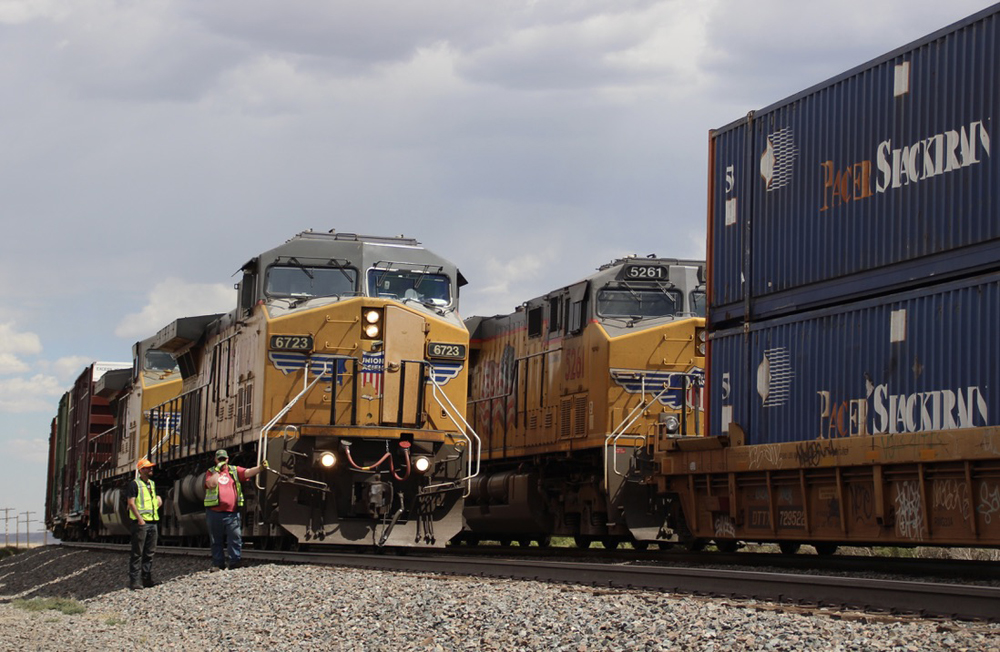
The Brotherhood of Locomotive Engineers and Trainmen and the Brotherhood of Maintenance of Way Employes Division will oppose the Union Pacific-Norfolk Southern merger despite UP’s promises of lifetime job protection.
“This debt-ridden tie-up won’t make rail more competitive with trucks as merger proponents claim,” BLET National President Mark Wallace said in a statement on Wednesday (Dec. 17). “We believe this transcontinental railroad will make shipping by rail less attractive as the merged carrier passes off rail lines that serve small towns, factories, and farms to short line railroads while running miles-long slow-moving trains on the main line. For rail customers it will be a choice between ‘hell or the highway.’”
The two Teamsters unions — which represent 53% of the combined UP and NS craft workforce — are the largest to come out against the $85 billion merger. The Transportation Workers Union, which represents carmen across Norfolk Southern’s northern tier, signaled its opposition to the deal when it was announced on July 29.
The BLET and BMWED also raised safety concerns about UP’s acquisition of NS, and urged federal regulators to closely examine UP’s safety record. Norfolk Southern, the unions noted, has improved safety since the disastrous February 2023 hazardous materials derailment in East Palestine, Ohio.
“UP continues to cut corners and oppose needed reforms,” the unions claimed. NS, they said, has been experimenting with the Federal Railroad Administration’s Confidential Close Call Reporting System that allows railroaders to anonymously report safety incidents, while UP has merely offered “lip service” to the program.
UP CEO Jim Vena said last month that the railroad will have the lowest personal injury rate in the U.S. this year. UP’s train accident rate won’t lead the industry, he says, but it has improved by more than 20% compared to 2024.
The unions also claimed that UP’s use of long trains, which has reduced the number of train crews the railroad needs, poses a safety risk.
Long manifest trains are more likely to derail than their shorter counterparts due to excessive in-train forces — and the number of wrecks related to train makeup and handling issues has increased sharply since U.S. railroads adopted Precision Scheduled Railroading operating models that rely on ever-longer trains, according to a National Academies of Sciences report issued last year. [See “Study: Derailment risk rises …,” Trains.com, May 29, 2024].
But UP says its proprietary Precision Train Builder software, which instructs yard crews on how to best distribute loads, empties, freight car types, and locomotives through a train consist, makes long trains safe to operate.
“Nobody else has that. We built it. It’s the best in the industry, and I measure that not by my opinion, but the results on mainline derailments associated with train handling,” Eric Gehringer, UP’s executive vice president of operations, said last month. “We’ve seen those go to nearly zero over the four-year period that we’ve had that tool. That’s a tool that we can bring to the NS … and put that on their railroad.”
The BLET and BMWED said that UP’s job-protection offer was an “empty promise” because it gives UP control over who is protected, who is left out, and when commitments can be changed or taken away.
“We don’t believe anything Vena says about how workers would be treated in the Supersized Union Pacific,” BMWE President Tony Cardwell said in a statement. “The agreements reached with some other unions related to job protections post-merger have loopholes big enough to traverse freight trains through. We refuse to accept the same terms in return for our unions’ support for the merger.”
The unions said that agreements other labor organizations reached with UP don’t protect seniority and would allow workers to be transferred to other locations or be demoted. Those deals also don’t address what would happen to workers in the event UP spins off routes to short lines.
“We’ve been around the track before with railroad mergers,” Wallace said. “Mergers can be messy and the very act of merging two railroad cultures creates safety risks. UP can do better. BLET and BMWE were open-minded to the merger when first announced. We reached out to Jim Vena on day one. We have met with Vena and others on his team over the past five months. The UP CEO has failed to convince us that he has the best interests of customers, workers and the communities served by rail on his agenda. As a result, it’s now our job, with the full backing of the Teamsters union, to convince the STB that this merger should be rejected.”
The BLET and BMWED decision opens a split among rail unions.
Five unions have reached formal job-protection agreements with UP and said they will support the end-to-end merger that will create a railroad with 52,000 employees. They include SMART-TD — the largest rail union overall, which represents conductors, brakemen, and switchmen — and the Brotherhood of Railway Carmen, the International Brotherhood of Boilermakers, the National Conference of Firemen and Oilers, and United Supervisors Council of America, which represents yard controllers on UP.
Some unions remain on the fence.
The International Association of Machinists this week said that it remains in discussions with UP, alongside the International Brotherhood of Electrical Workers and the SMART-Mechanical union.
“But given their track record with our members and the ongoing contract violations we continue to confront, there is a long way to go before the Machinists Union District 19 would consider endorsing this merger,” IAM District 19 President Reece Murtagh wrote in a Dec. 16 update to members.
UP and NS have said that since the merger will lead to traffic growth, they can offer lifetime job protection to unionized employees. The Surface Transportation Board will include labor concerns as part of its review of the railroads’ merger application.
“The growth opportunities created by this end-to-end merger enabled Union Pacific and Norfolk Southern to make a pledge that is unprecedented in railroad history: Every employee with a union job at the time of the merger will continue to have one,” UP spokeswoman Robynn Tysver says. “We’ve formalized this jobs-for-life agreement with five unions, including SMART-TD, the nation’s largest rail labor organization, and we look forward to filing our application with the STB this week.”
— Story updated at 11:50 a.m. Central with details from union news release. To report news or errors, contact trainsnewswire@firecrown.com.


Good to see that the BLET and BMWED see through Vena’s hollow job protection clams. Hopefully the IBEW, International Association of Machinists and SMART-Mechanical union will come out against the merger. As a retired IBEW member who served on the Local board I know first hand that if the company offers something that seems too good to be true then it usually is just that. As should be expected the company will ALWAYS try to leave their selves an out on what they’ve agreed. Unfortunately it seems that in the current political environment it only matters that one individual approves or disapproves of this merger.