





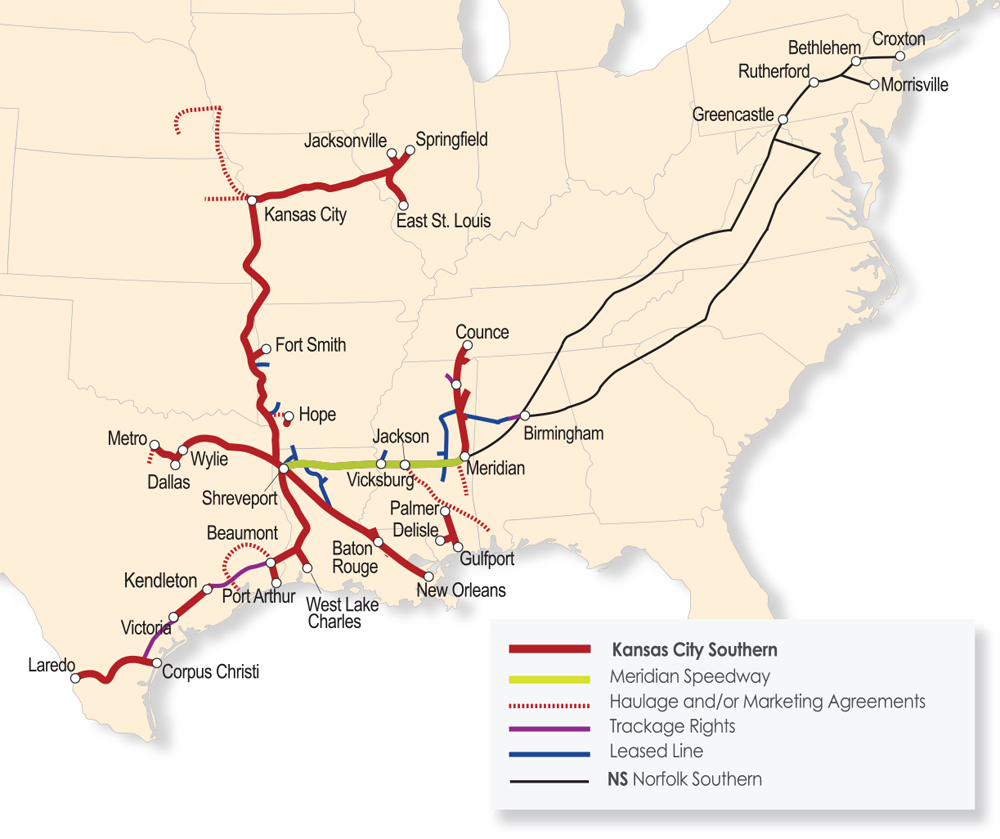
WASHINGTON — Norfolk Southern told federal regulators this week that it hopes to smooth over its dispute with Canadian Pacific Kansas City regarding operations over their joint Meridian Speedway.
But NS also said it disagrees with nearly everything CPKC has told the Surface Transportation Board about service over the 302-mile corridor that runs from Meridian, Miss., to Shreveport, La., and is a shortcut linking the Southeast and Southwest.
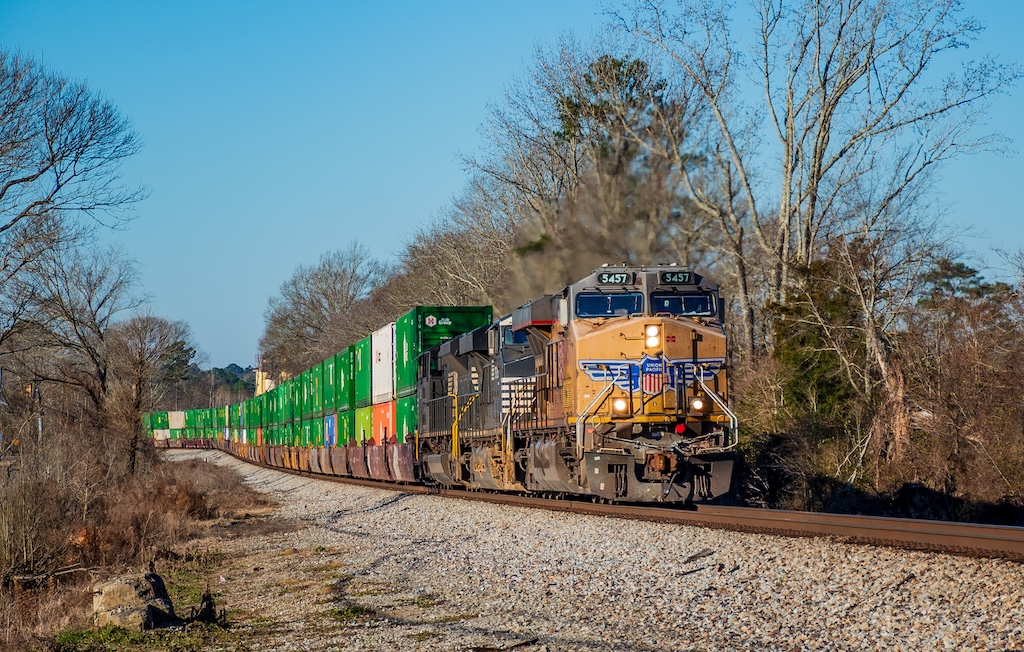
NS claims CPKC’s service has not been up to snuff since the Canadian Pacific-Kansas City Southern merger in 2023. In September NS asked the STB to enforce CPKCs merger-related promise to uphold service on the corridor, which carries NS intermodal trains linking Atlanta and Dallas as well as interline Union Pacific-NS stack trains connecting the West Coast and Atlanta. [See “Norfolk Southern claims Meridian Speedway service woes push freight to trucks,” Trains.com, Oct. 3, 2025]
CPKC claims it has lived up to its service commitments with the exception of a brief disruption that followed its troubled May 3 computer system cutover in former KCS territory in the U.S., and blames slow transit times on underpowered UP-NS trains. [See “CPKC disputes NS and UP complaints…,” Trains.com, Nov. 26, 2025]
“NS remains concerned that service over the Meridian Speedway has faltered since the CP-KCS merger and that significant business has been lost to the highway. Nevertheless, at this time, NS is optimistic that CPKC and NS will be able to reach a satisfactory resolution without the need for further Board action. NS reserves its right to renew its request for a Board order to enforce CPKC merger conditions or otherwise protect adequate service for customers if Board action becomes necessary,” Chief Legal Officer Jason Morris wrote to the STB on Dec. 10.
NS and CPKC have been sparring over Meridian Speedway operations since CPKC reimposed an 8,500-foot train length restriction over the summer. The move affected just one train: The interline intermodal train that NS and partner UP run between the West Coast and Atlanta.
The eastbound version of the train typically runs 11,000 feet, which is longer than all but three of the Speedway’s sidings. CPKC CEO Keith Creel has said that his railroad’s customers should not experience delays simply because UP and NS do not want to run their train to siding length.
CPKC has since lifted the train length restriction, NS told the board this week, and is running a second section of the train.
But NS said it disagrees with CPKC’s contention that its service meets contract obligations and its merger-related assurances.
“Most egregiously, CPKC’s response completely ignores the NS-CPKC interline intermodal business losses that we have incurred over the Meridian Speedway and the Meridian gateway since the merger,” NS said. “CPKC’s response only addressed the haulage business that moves over the Speedway, whereas NS’s September 30 filing covered both haulage and interline business. NS currently projects that we will have lost 100,000 intermodal loads over the Meridian gateway with CPKC since 2022 (the last full year of KCS’ per-merger operation of the Meridian Speedway).”
CPKC has said that the slump in intermodal volume is related to broader trends, including low trucking rates and a stubborn freight recession. NS acknowledges that some of the intermodal decline can be attributed to the joint CPKC-CSX service that was launched in December 2024, but says that the vast majority of the container traffic went back to the highway.
“CPKC promised highway diversions to rail in their merger application. What we have experienced over the Meridian Speedway is the exact opposite,” NS said.
Nonetheless, Morris wrote that NS and CPKC are making progress on ironing out their differences.
“After NS’s September 30, 2025 filing, CPKC agreed to temporarily reverse its unilateral decision to impose a train length restriction that was causing customer delays, and the parties have worked constructively to implement a compromise and ensure sufficient crews are available to staff trains transporting NS Traffic,” NS wrote. “NS has also been pursuing several avenues for private sector resolution of this dispute, including multiple Joint Operating Committee meetings, a potential third party audit of operational performance, and other mechanisms.”
NS and KCS formed the Meridian Speedway joint venture in 2006. NS invested more than $300 million in capital investments in the route in exchange for a 30% interest in the joint venture.
— To report news or errors, contact trainsnewswire@firecrown.com.



Dan, me thinks you are to set on cutting crews.
UP purchase is not going to happen. Already the Meridian – Montgomery route is growing as Schneider and others are starting to route more IM over that portion with upgrading for the whole route INCLUDING csx POTION to be 50 mph MAX. I can understand CP’s reluctance to spend the 70% the agreement may call for to improve the tracks. Maybe it will come to UP paying for most of the longer and any additional siding to a more reasonable 16k – 20k lengths. Then any time CP runs anything over 8500 feet will have to pay work around fee until CP pays for its part.of that improvements some fee?
The present CN crossing at Jackson will also need work as well the Vicksburg 20 MPH sections.
As far as crew it will become obvious the NS and surely UP can modify the agreement to use UPNS crews with operational rights install haulage by CP., It could easily become 2/3UP traffic.
This seems to paint Keith Creel as being “Hunter Harrison-Lite”. Being a tenant, one is very much a junior partner in the “deal.” It would seem logical for UP (the surviving company) to purchase the “Meridian Speedway.” (Meridian to Dallas). It would enable transcontinental traffic to bypass New Orleans, a reason for CPKC to extract what it can from UP.
Once UP has completed its purchase of NS (merger) look for UP (UPNS) to make a pitch to buy the CPKFC Shreveport-Meridian line. It’s a much better route between UP and NS than their interchange in Memphis or New Orleans. Without doubt, they would have to offer accommodation and even some concessions to CPKFC and CSX, which is upgrading the connecting Meridian and Bigbee railroad east of Meridian. But even taking into account CPKFC-CSX traffic, and whatever CPKFC traffic to Mobile, Gulfport, and ex-GM&O trackage in Mississippi, the potential for the most traffic and even new business is between today’s UP at Shreveport and today’s NS at Meridian. And as their own railroad, maybe UPNS would perform the necessary upgrades to handle the traffic, something CPKFC is likely hesitant to do, trying to recoup the $31 billion KCS purchase.
What path could there be to a North American RR industry that actually works together? This business of running interline cooperation like a 3rd grade playground with the STB as the teacher is ridiculous.
“NS and KCS formed the Meridian Speedway joint venture in 2006. NS invested more than $300 million in capital investments in the route in exchange for a 30% interest in the joint venture.”
This quote from the story along with “Super Rail Baron” Keith Creel ‘s assertion that his trains are more important than Norfolk Southern’s, highlights the problem here. Creel accepted the NS offer to, as Mr. Spindler suggested, “CAPEX” the line to the tune of $300 MILLION DOLLARS, no small investment in return for a 30% interest in the “joint venture.” A share or interest in a “joint venture” indicates in legal terms, a partnership even though it is a capped one. Still Lord Creel, if you are going to willingly take someone’s money to upgrade YOUR line, you ought to be decent enough to not hinder their rights for which they willingly paid for a result that you now seem to think you universally control. SO typical, always wanting something for nothing and then when getting it at no cost to him or his mighty railroad, he decides he ultimately determines how it is to be conducted. Where have we heard this before with Mr. Creel? As they say in the food manufacturing industry when regarding the presence of potentially damaging bacterial colonies in equipment: “Too numerous to count…”
Same old same old. With CPkc, the more things change, the more they stay the same. Glad to see that NS is at least trying to work things out in a congenial manner for now, but only time will tell if they end up having to sue to get what they are owed in the end. C’mon Creel… Just say what you will do, then do what you say. Is that so hard for the darling of Trains Magazine?
The “Speedway” name is a rather silly joke. The NS trains are supposed to “speed” 302 miles in 13 hours, or 23 mph. None of the users can be bothered with CapEx to improve the length or number of sidings.
The cat-fighting, grossly over compensated executives will spend more money on legal fees than CapEx.
Gee, NS could run shorter trains, not too complicated.
Not too complicated, but more expensive to run extra trains. NS doesn’t want to pay for a second set of CPKC crews over the line. The frictions aren’t operational so much as financial.
Dan I can assure you that without PSR managers telling people otherwise an 8,500 ft train would actually be wildly profitable
But two 5,500 foot trains would not be nearly as profitable as one 11,000.