





PHILADELPHIA — A federal appeals court has upheld dismissal of a lawsuit over a rail worker killed in a yard accident on the Port Authority Transit Corp’s PATCO Speed Line, saying the commuter operation does not meet the legal standard as a railroad.
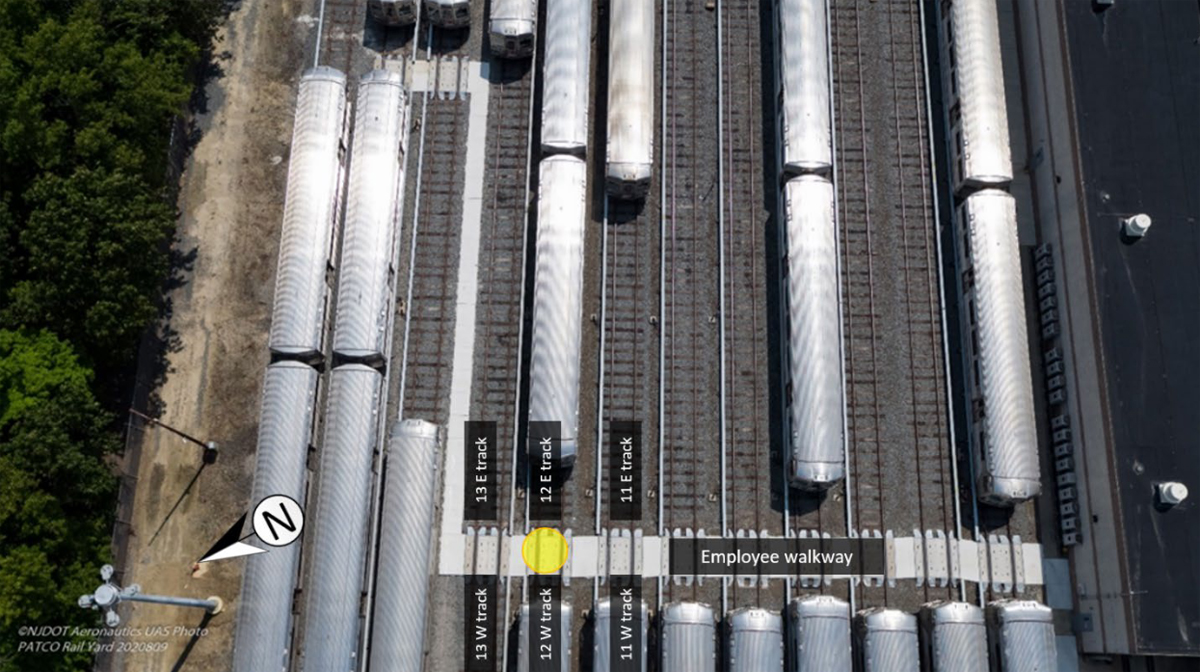
The Aug. 26 decision from the Third Circuit Court of Appeals, written by Judge Thomas L. Ambro, came in the case regarding John Schroder, a 76-year-old technician killed in a July 26, 2020, incident at PATCO’s Lindenwold, N.J., yard when he was crushed between two railcars during an uncoupling maneuver [see “NTSB issues reports …,” Trains.com, July 9, 2021]. The NTSB report on the incident, which did not identify Schroeder by name, found he was walking outside of a designated walkway at the time of the accident because the walkway was blocked by parked equipment.
The administrator of Schoeder’s estate sued PATCO and its parent, the Delaware River Port Authority, under the Federal Employers Liability, which permits suits over injury or death of railroad workers. The U.S. District Court for the District of New Jersey, however, found that the Speed Line was not a railroad but an urban rapid transit system, and therefore not subject to the FELA claim, and the appeals court agreed.
“A plaintiff who seeks to recover under FELA must … prove that the defendant is a ‘common carrier by railroad engaged in interstate commerce,’ rather than a more localized ‘urban rapid transit system,’” the appeals court says in its decision. [Emphasis in the original.] … If a railway resembles the kind of industrial operation that Congress meant to regulate, then it is a railroad. Otherwise, it is a rapid transit system that falls outside FELA’s scope. When we look at the Speed Line through this lens, it becomes clear that it is a rapid transit system, not a railroad.”
The standard set by FELA may be “an anachronism that has outlived its usefulness,” the court writes, citing an earlier decision, but until Congress amends the law, the court says it bound to “apply the statute as written by Congress and interpreted by the Supreme Court.”


Too bad for the deceased estate that they couldn’t capitalize on the unfortunate accident.
Doubtful if it’s some comfort to the deceased family that he wasn’t killed by a “railroad.”
But more important, was the point of the movement protected that the deceased stepped in front of?
Who was at fault, the employee or the railroad?
Another horrible tragedy that could have been prevented.
Upon review of previous article about the accident, it appears that the employee cut between two uncoupled cars less than 50 feet apart.
Several cars ahead of him, an uncoupling was occurring at the same time. As the cars were uncoupled, they rolled back and crushed him.
What a tragic coincidence!
He was at fault, but what was the safety climate on that railroad?