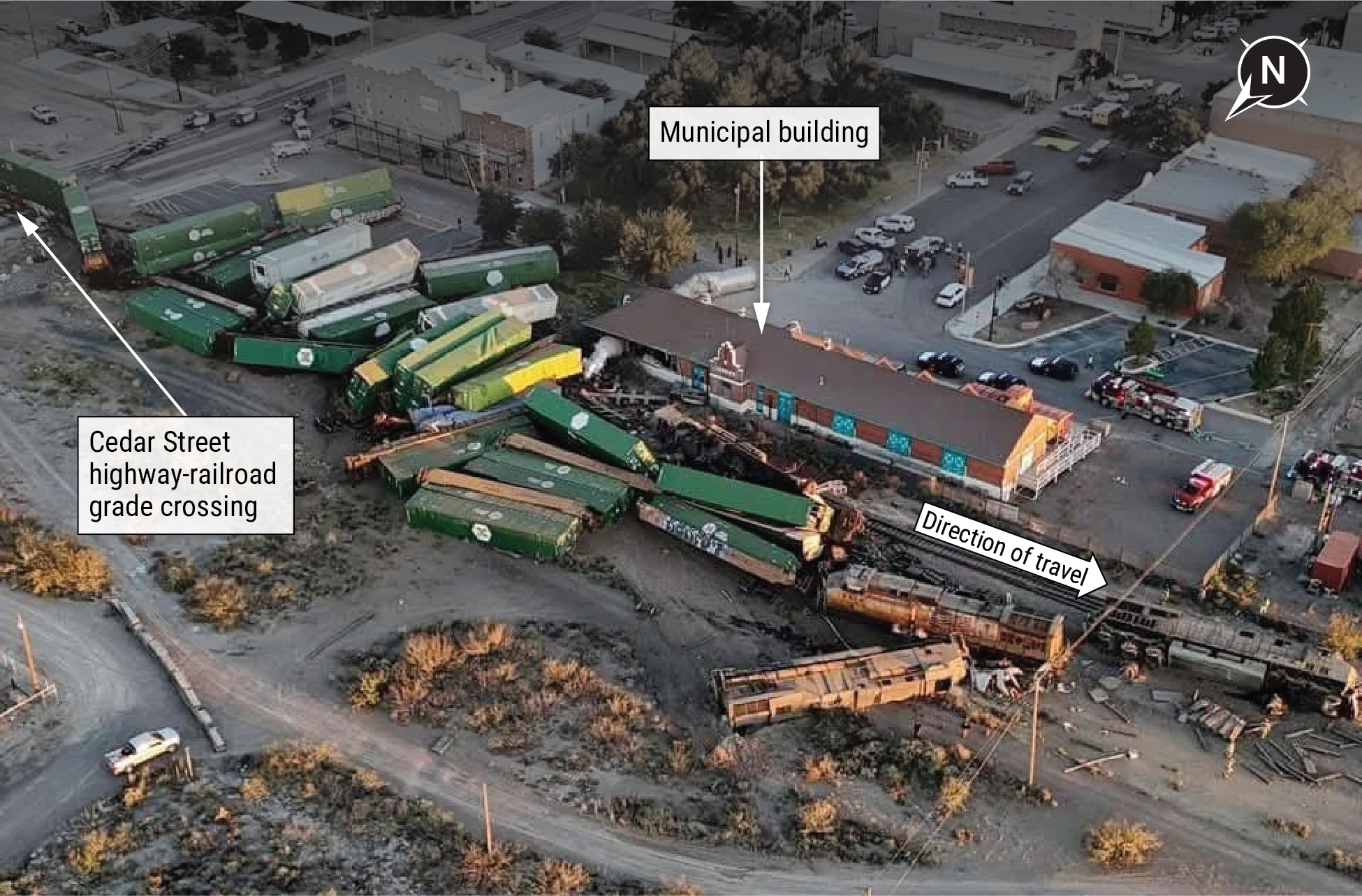
WASHINGTON — A Union Pacific Z-train was moving at 64 mph when it collided with a 45.5-ton piece of heavy equipment on a grade crossing in Pecos, Texas, last month, the National Transportation Safety Board said today.
The Dec. 18 wreck fatally injured the train’s two crew members, engineer Clay Burt and conductor Phillip Araujo.
A review of one of the locomotive data recorders showed the train had been moving at 68 mph before the crew initiated an emergency brake application shortly before the collision. The maximum authorized track speed in the area is 70 mph.
Train ZAILA-18, a Shreveport, La.-Los Angeles hotshot, struck a 2015 Peterbilt truck-tractor in combination with a 2016 Scheuerle hydraulic platform semitrailer that was carrying an oversized load, the NTSB said in its preliminary report on the collision.
The load, a demethanizer tower used in the oil and gas industry, was being transported from Houston to Mentone, Texas, a town in the Permian Basin oil patch 23 miles north of Pecos. The tower was 12 feet wide, 116 feet long, and weighed 91,000 pounds, the NTSB said.
“A single driver operated the combination vehicle, which was escorted by two pilot vehicles and a uniformed police motorcycle escort,” the NTSB said, noting that the Texas Department of Transportation authorized the route for the oversize load handled by Boss Heavy Hall LLC. The Cedar Street grade crossing in Pecos, where the accident occurred, was within the permitted route, NTSB said.
“The combination vehicle entered the highway-railroad grade crossing about 1 minute before the collision,” the NTSB said. “The grade crossing was equipped with flashing lights, crossbucks, gates, and bells. The grade crossing’s warning equipment activated and signaled the train’s approach while the combination vehicle was blocking the railroad tracks.”
As a result of the 5 p.m. collision, the four head-end locomotives and the first 11 stack cars derailed. Some 9,000 gallons of diesel fuel spilled from the locomotives’ fuel tanks.
The collision displaced the combination vehicle’s load, which struck the former Texas & Pacific train station and injured three bystanders in the building, who were later treated and released at a local hospital.
The NTSB said its ongoing investigation will focus on “site modeling, accident data analysis, highway railroad grade crossing safety, locomotive cab survivability and crashworthiness, and carrier requirements for traversing grade crossings while transporting oversize loads.”
While on scene, the safety board reviewed radio logs and surveillance camera video; conducted interviews; made sight distance observations; examined the track, signals, locomotives, and cars; examined the grade crossing equipment and the combination vehicle; reviewed Boss Heavy Haul’s policies, procedures, and training programs; and recovered data from the lead locomotive’s event recorder and external and internal facing cameras.
Share this article