





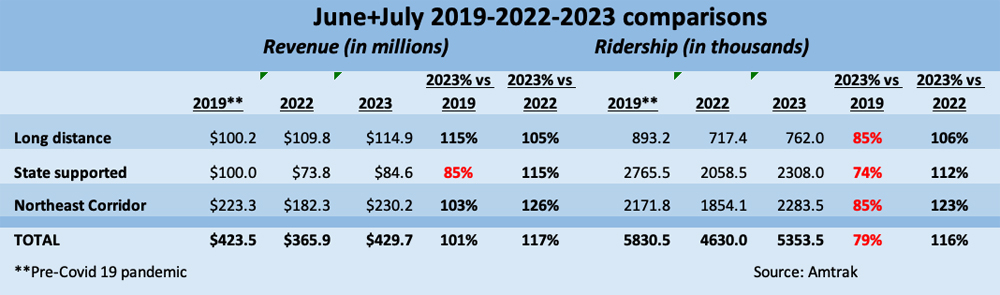
WASHINGTON — Though Amtrak ridership for June and July 2023 did not reach pre-pandemic levels for the same months in 2019, a review of company statistics shows systemwide revenue beat the total for those months thanks to strong performance from Northeast Corridor and long-distance service.
Frequency and capacity played a part in the performance shown in the table below for those two service groups, as well as the company’s third, state-supported services.
Losses and gains for state-supported routes
The commuter-dependent California, Pennsylvania, and Midwest corridors showed marked improvement over summer 2022; still, a decline in weekly passenger trips meant that was the only one of three service lines with declines in both revenue and ridership. But Maine’s Downeaster, New York’s Empire Service, and Virginia’s Northeast Corridor-linked service to Newport News, Norfolk, Richmond, and Roanoke set monthly records in July compared to July 2019.
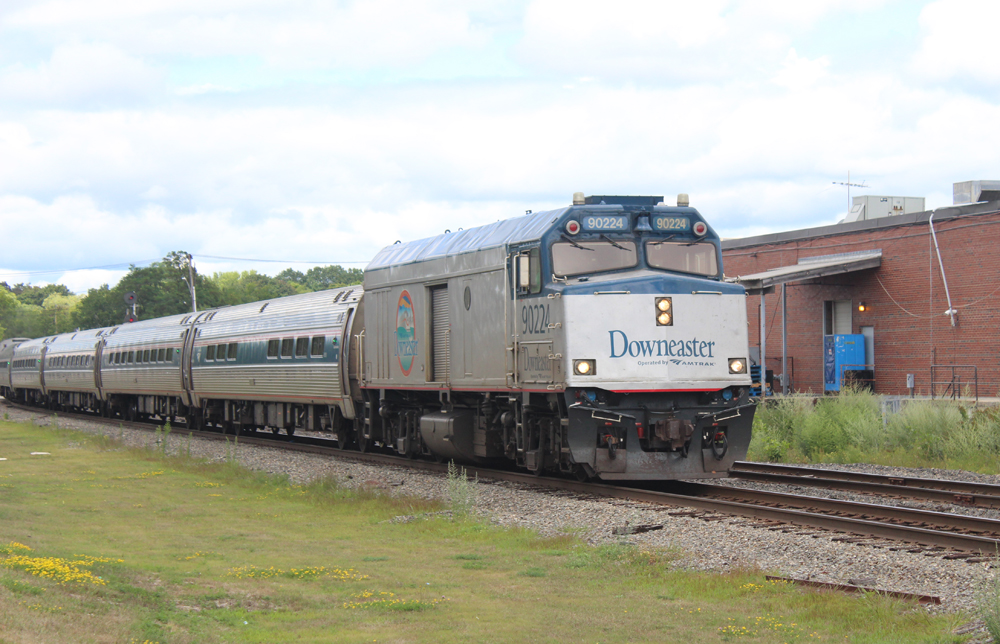
The Boston-Brunswick, Maine, corridor delivered its highest fiscal year revenue ever through June. Also in the east, Empire Corridor patronage was up more than 7%. Both the Virginia trains and North Carolina’s Piedmonts benefitted from additional frequencies compared with July 2019. Monthly Virginia passenger counts rose 27% to 125,656 and Charlotte-Raleigh, N.C. ridership registered a whopping 59% gain to 25,732, not including the state-sponsored Carolinian.
On the strength of strong Northeast Regional ridership, Northeast Corridor departures managed to edge out their combined June and July 2019 delivery, with the Acela side showing an increasing ability to command higher prices than in previous months.
Stunted long-distance growth
What those regional services have in common are multiple frequencies and long enough trains to accommodate travelers at competitive fares. That was not the case on the long-distance network, whose ridership and gains should have beat the other categories.
Prior to the upcoming Labor Day holiday weekend, Amtrak has added a second Superliner coach to the Chicago-Washington Capitol Limited after operating only one coach and one sleeping car for most of the year. Nevertheless, as of Aug. 27, even with the additional car, the westbound Capitol is sold out on eight of the next 12 days at $201 for a Chicago-Washington coach seat. Roomettes ($643 for one adult) and/or bedrooms ($875) are available on half of the days.
On Friday, Sept. 8, the first date Capitol Limited coach seats are available for an extended period, a through fare to Orlando, Fla., is priced at $504 on www.amtrak.com, using a combination of the Capitol connecting to the Silver Star at Washington. People traveling from Chicago to Orlando, of course, have many other options: economy prices on United Airlines’ five nonstop flights on Sept. 8, booked on August 26, ranged from $99 to $164. But Amtrak’s inherent travel niche — using the Capitol and Star journey as an example — is that there are more than 30 intermediate stations between Chicago and Orlando where Amtrak offers service. If the rail option is not available because of a lack of equipment, or if prices are not competitive with the remaining alternatives — such as driving or not taking the trip at all — people won’t buy tickets. On an interconnected system like Amtrak, the ramifications are obvious.
In July, with the Capitol Limited operating with constrained capacity resulting in daily sellouts, the train’s patronage was off 49% from the same month in 2022. In June, the year-over-year decline was 52%. The 19,229 fewer passengers translated to $1.815 million in lost revenue for those two months alone.
After leading ridership demand and revenue among Amtrak’s three business units since COVID-19’s impact began to decimate Northeast Corridor and state-supported routes in March 2020, overall long-distance ridership was only up 3.7% and revenue 5.5% in June and July combined.
Impact on connections
With consists reduced on many trains throughout the long-distance network, the only reason the category eked out positive results is that the Crescent and City of New Orleans ran just five days per week last summer and the Silver Meteor didn’t operate at all. Combined Star-Meteor patronage is up 26.6% and revenue up 22.2% for June and July compared with Silver Star figures in those months in 2022. But it would be naive to conclude that high-priced connecting segments and the absence of always-available daily feeders didn’t handicap these two trains — indeed, performance throughout the entire network — throughout this summer.
Management’s inability to prioritize a return to service many of the cars and locomotives it parked in October 2020 continues to exact a cost. As recounted in “How to kill a network,” [pages 18-19, September 2020 Trains] Amtrak CEO Stephen Gardner, then senior vice president, told employees in a May 27, 2020, “town hall” virtual meeting, “Now the good news: it is much easier to expand service than to reduce it.”
That may have been true for the Northeast Corridor’s generous frequencies and eight-car consists, but other state-supported trains and long-distance routes have had difficulty responding [see “Amtrak long-distance equipment shortage, mechanical challenges continue,” News Wire, Aug. 24, 2023].
Seeking the sweet spot
Equally limiting is high prices keyed to the diminished capacity, coupled with a lack of readily available and usable information for potential new customers about where the trains go, when they leave, and how they connect. That combination, along with sidelined assets not generating revenue, has clearly weakened the network’s viability, and thus increased the cost of providing an interconnected system.
As Amtrak formulates its operating plan for fiscal 2024 beginning Oct. 1, 2023, the traveling public will begin to see whether any of the current shortcomings are addressed.
In a CNBC “Power Lunch” interview last week to address the surge in summer travel, Amtrak President Roger Harris said, “Ridership is up about 10% and we’re benefiting from some of the air traffic delays, and we have some great new equipment coming on line to meet the needs of these travelers.”
When asked if Northeast Corridor fares might come down at some point, the Amtrak president said, “On the less popular trains, you’ll see the potential for lower prices. We seek to get more overall utilization out of the trains because that really is where the sweet spot is for the business — [it’s] getting the most utilization out of the assets we have.”
That has been Amtrak’s challenge all along.





I think a lot of people share my opinion that the odds in a lottery, or in a Las Vegas Casino, or at a local Bingo game for that matter are all better than having a long distance train trip go exactly as planned with no equipment malfunctions, or cancellations, and an on-time arrival. Step right up! Place your bets…
Contributing to the sense of disfunction, the comparison table above has math errors in the 2019 vs. 2023 ridership column. For example, the table shows NE corridor ridership increased 2.172M to 2.284M. Yet the table says 2023 ridership was 85% of 2019 ridership. The correct number is 105%.
Given how we have learned to distrust Amtrak’s Izvestia approach to data compilation and surveys pronouncing “eager”public support, how valid are Amtrak’s financials re revenues and costs? Without an independent, external audit to validate Amtrak’s financial submissions; without in-depth scrutiny as provided by Bob Johnston, how do we identify the BS when Amtrak has massaged and manipulated these numbers to cover deliberate efforts to shift costs, e.g., cover excessive NEC costs by shifting these financials to bury the long distance sector?
Despite CEO Gardner’s attempt to rely upon his Capitol Hill exploits to explain failure in command decisions by deflecting inquiries with a “smoke & mirrors” response, we know why Amtrak’s consists today are crippled, running short and below summer season travel demand; why schedules are sabotaged due to mechanical issues before departure. As clearly evidenced in Bob Johnston’s quote here, Amtrak’s President Harris statement to CNBC proved the end result of what happened when we learn how ‘the emperor wears no clothes.’
Frankly, for Harris to talk so superficially about “utilization of assets” succinctly explains how the dearth of competent corporate management missing the requisite experience in railroad operations now clearly explains how such blatant naïveté could cut the seasoned maintenance, operations, and OBS workforce at the beginning of the pandemic. Apparently, these former airline folks did not have the benefit of knowledgeable mentors to point out how the Burlington excelled in asset utilization by same day turning the “Twin Cities Zephyr” consists in both Minneapolis and Chicago; Wabash and GM&O turned consists of “Blue Bird” and Abraham Lincoln” in Chicago back to St. Louis.
Whereas, Amtrak continues to re-define “asset utilization” by ignoring the concept and requiring multiple consists to cover its excessively padded schedules, e.g., “Lake Shore Limited,” “Capitol Limited,” and “City of New Orleans.” Consequently, today, Amtrak runs “milk trains” over previous fast overnight schedules to facilitate its penny-pinching mentality to prioritize avoiding hotel/meal costs of perpetually late connecting western trains.
Amtrak has devolved from the days of Reistrup, Claytor, and Gunn into a classic Harvard B-School case study defining the importance of experience and mentorship for corporate management; to know what business you are in; to create the correct business model to support how to competently operate that business. No matter how much new equipment is on order, without competent, knowledgeable decision-makers in management, and a seasoned Board to hold all accountable for their decisions, an abbreviated “Capitol Limited” and “Texas Eagle” absent dining/lounge cars would not be the worst scenario.
I like to ride Amtrak’s long distance trains. However with the equipment shortage and poor on train service like lack of access to the dining car for coach passengers or no lounge car in the consist I am one of those people preferring not to travel. Lucky for me I have traveled in years past for both business and pleasure on Amtrak’s various trains. The management needs to get back to the old railroads way of doing business. They would do whatever possible to keep trains running and maximize revenue by adding cars or trains at peak times to meet demand,waiting for new cars is not the solution. Get as many of the older cars back in service as possible. When the new cars come on line look to rebuild as many of the old cars to good working order and add service where it helps gain revenue. If the older cars are not as nice as the newer cars then add a new class of service such as economy class and see if that adds demand for the existing or new trains they could then run. Cutting consists and services does not meet the reason Amtrak was started in the first place. Amtrak was created to serve the whole country, not just the north east and other short distance routes. As noted many of the shorter runs in the past were used to connect with some of the longer distance trains or riders on the long distance trains connected to the shorter routes to reach the city or town they wanted to reach. Not to mention Amtrak also serves many smaller towns where they are the only public transit available but if the trains are sold out then they can not travel.
To Mr. Sell’s comment above (and others), yes Amtrak is dysfunctional (and badly broken!).
To the Amtrak President’s quote in the article – “We seek to get more overall utilization out of the trains because that really is where the sweet spot is for the business — [it’s] getting the most utilization out of the assets we have.” – well, that’s fine and dandy, but if your “assets” are either 35-40 year (+) passenger cars that aren’t reliable or keep breaking down OR is new technology/new equipment that either isn’t reliable or keeps breaking down, well then you aren’t “getting the most out of your assets…”
Wasn’t Amtrak supposed to improve and get better once “Amtrak Joe” got elected?
Where is “Mayor Pete” (USDOT – Tsp. Secretary) and why isn’t he laser-focused on improving a clearly-failing national passenger rail system otherwise known as Amtrak? Maybe he is busy preparing to give a speech about transit “equity” instead ….
Service is terrible and I have a feeling little will be done to get equipment back into service. I see a refrain of , ” we have new equipment coming”. We’ve seen how well that’s worked out. Everything new sits in the yard until the mistakes are corrected. How’s the performance of those new electric trains working out? Or the Siemen’s cars that sat for months in Chicago ?
At least 6 sets of the Acela replacements sitting in Penn Coach Yard rusting to the rails in Philadelphia.
Amtrak, disfunctional!
I’d love to use it but in our corridor the eastbound runs so late that I can’t guarantee making an eastbound connection out of Chicago on the same day so I’d have to get a hotel and take the next days train. Have to add meal costs also in Chicago which isn’t terrible as I do have some favorites.
“AMERICA’S RAILROAD” does not serve most American’s very well . . .