





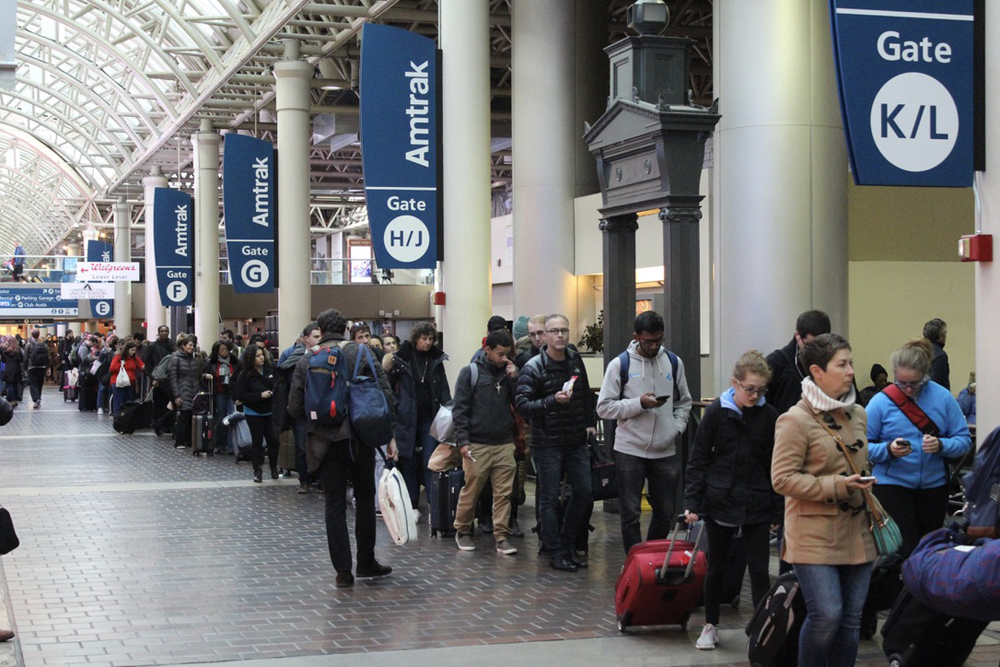
WASHINGTON — In a departure from the post-Thanksgiving “Track Friday” sale that Amtrak has staged since 2016, this year’s version is only available from Maine to Virginia in the Northeast instead of on most routes nationwide.
Through today (Monday, Nov. 29) the company is offering “Buy One, Get One Free” companion fares between Jan. 4 and April 30, 2022, for Northeast Corridor and Maine’s Downeaster routes only. Two people must travel together, and no upgrades from Northeast Regional coach or Acela Business Class are permitted.
The fares are also good in coach on those portions of the Cardinal, Palmetto, Silver Star, Silver Meteor, and Carolinian operating between Virginia and New York City, but are not available on Keystones to Harrisburg, Pa., or Empire Service trains to Albany-Rensselaer and Niagara Falls, N.Y. The companion fares aren’t being offered April 15-24, 2022, around the Easter holiday.
Bookings can be made through “Cyber Monday” using this link or entering code C420 if using the Amtrak app.
Previous versions of annual “Track Friday” sales featured advance purchase discounts for single trips rather than companion fares, and they were good for coach travel throughout the country except on certain state-supported routes. They also always began in early December following the Thanksgiving weekend [see “Analysis: Big-picture flaws in Amtrak’s latest fare sale,” Trains News Wire, Nov. 30, 2019]. Discounting started at 30% in 2016, rose to 35% in 2019, and 50% last year.
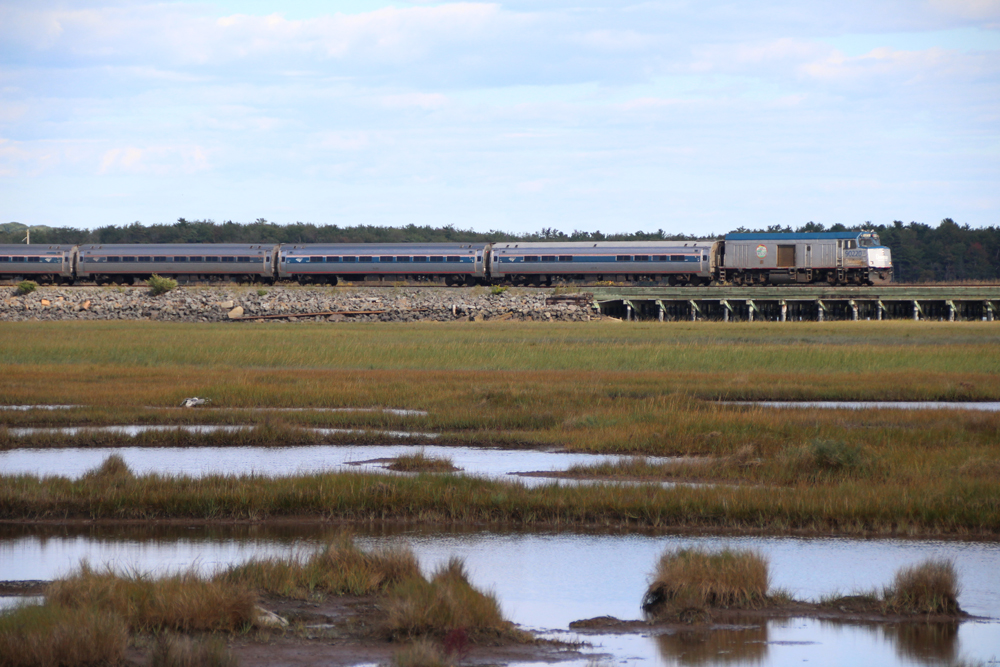
Amtrak primary promotional activity in recent years has been discounted fare sales, but in order to stage them nationwide, states who operate the service must agree to the discounting, and there have always been exceptions. For 2022, only the Northern New England Passenger Rail Authority and Virginia Passenger Rail Authority had to sign off on the deal.
The sale’s limited scope reflects Amtrak’s reduced equipment availability on long-distance and state-supported routes outside of the Northeast Corridor, and signals that sidelined cars won’t return to service anytime soon. The company did manage to add one additional Boston-Washington, D.C., round trip on the Sunday after Thanksgiving, but not the usual extra trains supplement [see “Amtrak trains during the holidays,” Trains.com, Nov. 22, 2021].
Service reductions possible because of vaccination rule
Immediately preceding the decision to limit free companion fares to regions where trains are frequent was the announcement to employees on Nov. 22 by Amtrak President William Flynn that effectively moves the company’s mandatory vaccination date from Dec. 8, 2021, to Jan. 4, 2022.
In a letter to employees, Flynn reveals, “To date, 88.2% of all employees and 94% of employees we expect to be available for service in December have gotten at least one vaccine shot.” He says that although the mandate for all employees to be fully vaccinated and report their status by Dec. 8 is unchanged, those who don’t comply may now remain in service until Jan. 4. Flynn notes that the decision to enforce compliance in January reflects the Biden Administration’s executive order extending the deadline for federal contractors.
He adds, “Amtrak will publish a revised service schedule by mid-December, based on our then-current vaccination rate. The company continues to prepare for the possibility that some number of employees will choose not to get vaccinated and will therefore be leaving the company, which could necessitate some temporary reductions of Amtrak service.”
Flynn had previously informed employees of possible service reductions when announcing an earlier extension of the vaccination date [see “Amtrak extends vaccination deadline …,” News Wire, Oct. 28, 2021]. At that time, the company had planned to issue the revised schedule in mid-November.
Because conductors and engineers are only qualified on routes they normally operate, personnel with those skills can’t move from one region to another without going through route-specific re-qualification. Onboard service employees can move to different crew bases to fill empty slots, but furloughs and layoffs dating from the October 2020 to May 2021 reductions of all long-distance routes except Auto Train to tri-weekly departures have thinned those ranks.
Unions file suit against Amtrak mandate
Meanwhile, the Brotherhood of Locomotive Engineers (BLET) and the International Association of sheet Metal, Air, Rail, and Transportation Workers’ Transportation Division (SMART-TD) went to court in Chicago on Nov. 23, filing a lawsuit charging that Amtrak must negotiate with the unions over the vaccine mandate as part of its bargaining agreement.
The Cook County Record reports the unions are asserting that Amtrak workers are neither federal employees or federal contractors, and therefore are not subject to a federal executive order.
The unions have similarly objected to the imposition of vaccination mandates in suits recently filed against Union Pacific, Norfolk Southern, and BNSF Railway, arguing that the requirements represent a major dispute under terms of the Railway Labor Act. In those cases, the union suits were in response to suits filed by the railroad, seeking to block potential strikes or other work actions.





All of this nonsense about jabs is so much hysteria, and illustrates total disregard by certain sheeple for matters of individual freedom and choice concerning their own person. There is more manipulation and greed by commercial media and Pharma than any credence to arguments about jabs being necessary other than, arguably, being advisable for a minuscule percentage of vulnerable persons. Other than that – the jab indoctrination merely perpetuates the drive-thru lanes at drug stores that are becoming like Taco Bell on a Friday night. As with climate hysteria, it’s a matter of stampeding opinions with a good scare and large helping of outright lies.
“Those who would give up essential Liberty, to purchase a little temporary Safety, deserve neither Liberty nor Safety.” B. Franklin.
Seat belt laws are more repressive than any immunization rules if you’re spreading covid your a danger to the entire public if you don’t wear a seat belt you’re only endangering yourself as for being justified because the public has to pay for hospitalization the same is true for covid in addition to the fact that outbreaks of covid can cause a domino effect & fill up hospitals to capacity thereby denying medical care to others with other health issues. One alternative would be for insurance companies to take the lead and deny coverage to those who do not get immunized/wear seat belts and are hospitalized.
I really, really, hugely like that idea: “…insurance companies to take the lead and deny coverage to those who do not get immunized…”. I cannot understand why they haven’t. Regarding the BLET and SMART-TD members who still work for Amtrak after the ill-advised furloughs in October 2020, they better not complain when Flynn and Gardner once again cut the LDs to tri-weekly operation. In fact, if they do Congress ought to step in and direct Amtrak to just discontinue those trains. Believe me, I want to see those services not just survive but grow. But they haven’t in 50 years. In fact they’ve shrunk. They make little enough impact on the transportation scheme of things with once per day service. Tri-weekly? Again? No thanks.
Once again the unvaccinated are to blame. Then explain the infection rates in countries like Israel that almost the entire population is vaccinated. This is about money and politics. Not science. Let the thing run its course and be done. What variant of the Spanish flu are we on? What about natural immunity? If the vaccine works so well why all the boosters? Who pays ten years from now if we find out there are serious health repercussions from the experimental jabs?
So following all this reasoning about “You can do whatever you want to yourself, but it’s my business if the public has to pay for hospitalization (which I guess is the legal justification for requiring my seat belt use), then here’s my question: If I want to kill myself, I can. If I mess up and just end up hospitalized and on the public tab, why isn’t “Attempted Suicide” a crime, like failure to buckle up, or walking around in California without a mask? Seems inconsistent.
100% pro highway speed limits but against mandates. It’s an individual’s choice.
If the vaccine actually works, what do the vaccinated have to fear from the unvaccinated?
Patrick: Here are several reasons why I , as fully vaccinated and boosted, care about others getting vaccinated:
1: the vaccine is designed to significantly reduce serious infection and hospitalization but not eliminate minor infection. So I do want as many others to be vaccinated to reduce the chance I get a breakthrough infection.
2: The more people that are vaccinated the less the probability of variants developing and some of them may be vaccine resistant.
3: All of us vaccinated folks end up paying for the medical care/hospitalization of those that choose not to be vaccinated and I want to reduce that medical cost as much as possible.
So there are three reasons why I care (not necessarily fear) about people choosing not to get vaccinated.
Right on. Do not some one initiating a variant or an un vaccinated causing me to spread C-19 ( what ever greek letter) to my infant grandkids.
right on. Same opinion about those pesky stop signs.
(note this comment is sarcasm for the sarcasm-challenged)
TO “If the vaccine works, what do the vaccinated have to fear. ” I reply that my wife and daughter are nurses and while they are not at risk because they are not currently caring for patients, Those who do NOT get vaccinated and DO need medical care put the medical staff at risk and also fill hospitals preventing others from getting the care they need. Those who choose to resist the vaccine in my opinion are being selfish and ignoring the greater good,
100% pro-vaccine but against mandates. It’s an individual’s choice.
I concur it’s an individual’s choice but isn’t it also a choice of the employer to institute reasonable health and safety measures (I can think of mandatory drug testing as an example)
Employer’s choice but not Joe Biden’s. He has no power to require. His minions know that. As for Joe himself, he no longer knows his bum from his elbow — or maybe he never did.
Wow, the bots got onto story. Unrepresentative sample, shall we say.
#CivilWarForKilling
Just get the vaccine and get through this.
MARK — I’m 100% pro-vaccine – as is my wife and all of our physicians. Of course we’re both vaccinated, although so far only one of us has had the booster shot. Having said that I’m against mandates for a number of reasons. There are many arguments against the vaccine, ranging from the perfectly absurd to the somewhat plausible. I shouldn’t force my beliefs onto someone else.