





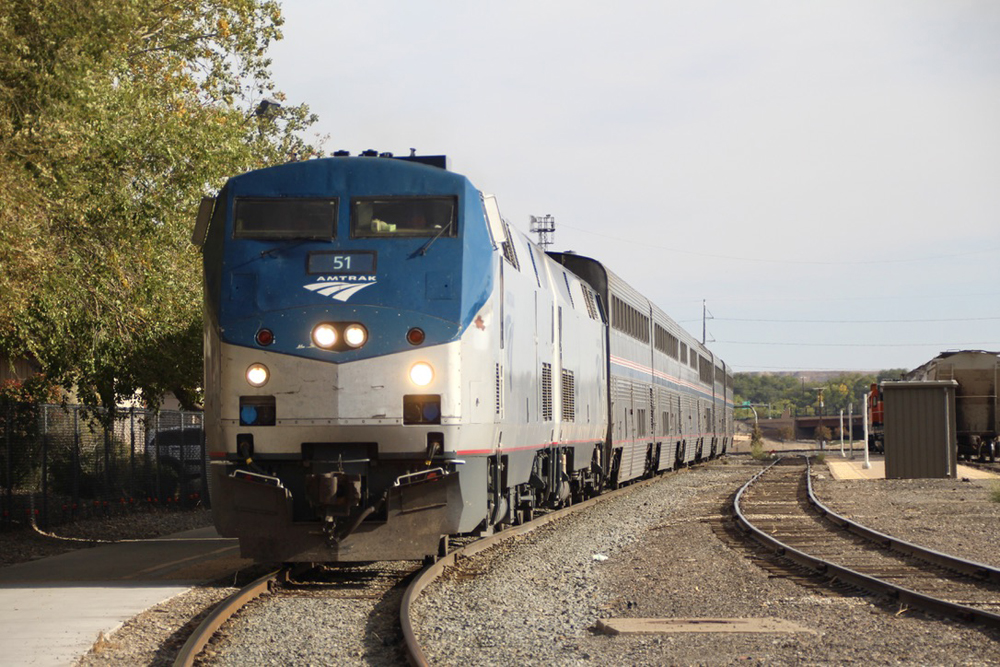
CHICAGO — Amtrak’s westbound California Zephyr has been cancelled this Sunday, Sept. 25 — continuing a week of disruptions for the service between Chicago and Emeryville, Calif.
The sequence that led to Sunday’s cancellation began with the westbound departure of Monday, Sept. 19, which sustained delays totaling 16 hours, 35 minutes on its way to Emeryville. With the equipment and Chicago-based onboard service crew on No. 5 arriving less than an hour before train No. 6 was scheduled to depart, the eastbound Zephyr of Sept. 22 never left the station.
Perhaps prophetically, the CZ trainset that headed west on the 19th was missing a Sightseer Lounge car (as was that day’s Southwest Chief). This was became less of an issue for the Zephyr when delays meant it passed through its signature mountain scenery at Glenwood Springs, Colo., after 1 a.m. Wednesday and at Truckee, Calif, at 3 a.m. Thursday.
Reasons for the extreme tardiness were unavailable, but tracking information shows the train went from 17 minutes behind to 3 hours, 16 minutes late in the 76 miles between Holdrege and McCook, Neb., then was held in McCook for 5 hours. It departed Denver 10 hours off the advertised at 6:27 p.m., and left Salt Lake City nearly 15½ hours late at 2:55 p.m.
With no lounge to provide food for coach passengers, they were offered café fare and beverages in one half of the Superliner dining car, which otherwise would have been off-limits to them.
This Zephyr and Sightseer Lounge episode is the latest illustration how Amtrak management’s decision to reduce shop forces beginning in fall 2020 continues to plague its overburdened Superliner fleet and the passengers who depend on it.
The company has never been flush with enough spare cars and locomotives in the Superliner era to maintain a spare West Coast trainset to protect against delays for the Zephyr in the San Francisco area (or for the Empire Builder in Seattle or Portland, Ore.). But there were always enough “protect” cars in Chicago and Los Angeles to assemble a complete consist because each terminal hosts at least three long-distance trains.
Not so in 2022. The Zephyr has been operating with only two coaches and two standard sleeping cars, one less in each category than in previous summers. As a result, sellouts have been common, exacerbating the ability to accommodate travelers displaced from cancelled departures.
The loss of a complete set of equipment when the eastbound Southwest Chief struck a dump truck in Missouri on June 27 exacerbated the problem, but the company had declined to adequately beef up its maintenance capability throughout the year before the accident.
Since daily service was restored in May, each of Amtrak’s cross-country routes out of Chicago has missed more than one round trip after a badly-delayed train arrived too late to turn back at its West Coast terminal.
And while Sunday’s cancellation may provide the opportunity to break the cycle of Zephyr cancellations, it will not assure that everything is going smoothly on the Chicago-Emeryville route: Friday’s westbound departure left Chicago at 5:01 p.m., instead of the scheduled 2 p.m., because of what the Amtrak Alerts Twitter feed called “an unforeseen mechanical issue.”




My wife and I took the Zephyr on Sept 8 from Chi to Sacramento. We drove to Chicago because neither Amtrak nor the airlines are reliable enough to make a same day connection to the Zephyr. We rolled out of the Windy City right on time. We only lost a little across Illinois and were within about 20 minutes into Denver. (Although there sure seemed to be a lot of low joints on the Burlington across Iowa). Not to bad.t Then we got a little later later as we went across the Rockies.
I woke up the next morning to the Nevada desert. But at 6:20AM we had not yet reached Elko which by the schedule made us 3 hours late. Over course of the day we lost another one and a half hours. We arrived in Roseville, CA more than 4.5 hours late. We got into Sacramento (20 miles from Roseville) only 3hours 45 mintes late. Huge schedule pad.
Because of the potential of the strike we cancelled our return on the Empire Builder, and even though I hate flying I was glad to return to Chicago that way. I will never take a US long distance train again until all things improve on both the Amtrak and rail lines.
I don’t think remarks about flyboys is meant to disparage airline management. Its pointing out the fact that trains are not planes. Canceled trains due to a potential snow storm? We joked they could not find any deicer to spray on the trains. Poor decisions being made by folks with no railroad experience at all. Gardner is nothing more than a high ranking congressional aide who rode a train. We all know where his priorities lie. As for meals. Flying in SE Asia the local airlines I used you ordered a meal when you booked and paid for your reservation. Why couldn’t this be done by Amtrak? Menu options with prices available when you book. Limited meals would be made available on the train for those who don’t book a meal in advance. This should cut down on waste.
The other problem with dining service are the union contracts. Anyone remember the screaming and hair pulling when Amtrak planned on allowing Subway to staff cafe cars between Albany and NYC?
And yes. Poor management decisions have lead to the current equipment debacle. I, too, scoff at current service expansion plans. Why isn’t Amtrak working in ordering new LD equipment using the current viewliner platform? There are already new sleepers, diners and baggage cars. Take the shells and build some coaches, cafes and business class. Seems an easy solution.
I agreee. Pre-order microwave meals and alcoholic drinks, with your ticket if a certain number of hours in advance. Snacks and coffee and soda for those who don’t preorder. LD’s could have a couple of commissaries/ caterers on route, at the third points.
Prices? On United Airlines, a tasteless snack box, gloriously called “tapas”, is $10 or $11. A small wine bottle, rather decent, is $9.00. Ain’t cheap any more.
Trains have an added expense. The dining car. Microwave or not, it’s a lot of iron to haul (and to buy, and to maintain). On an airplane, you eat at your seat, no matter the class or the ticket price.
Well said James
I travel from central Virginia to White River Jct., Vermont at least once a year to visit my elderly mother. Early in the 2010’s I would fly Jet Blue non-stop to Boston and rent a car for the 2.5-hour drive up I-93 and I-89. If you get a car at Logan they levy a tax well in excess of $100 for a week’s rental. I could fly to Hartford, CT, or Manchester, NH, but lengthy layovers in Philly, Newark, or other airports make that option much less attractive.
I have also ridden Amtrak on numerous occasions. The Ethan Allen Express has fairly reliable connections at NYP from Richmond but arrives in Rutland VT at night and requires an hour-long cab, limo, or Uber ride. Penn Station is crowded and not very pleasant.
The Vermonter stops in WRJ, about 5 minutes from Mom’s house, but requires a 2-hour drive in morning traffic up I-95 into DC because there are no connecting trains from Richmond. Motorists do have the option of using the express lanes on 95 but the tolls into DC are unreasonably high. The Silver Meteor (which hasn’t run since February if memory serves) is carded through Richmond at about 4 AM, but Amtrak won’t guarantee the connection, with good reason given its poor on-time performance.
So, therefore the last 4 trips I have chosen to drive my 2007 Honda Accord. I stop somewhere in NE Pennsylvania or southern New England, and maybe do a little railfanning on my way up or back. The routes I take offer plenty of opportunities to catch some railroad action. Sure, it takes a lot longer, but once I get north of Frederick, MD. it’s an easy drive with no hassles from the TSA or other authorities. Plus, the scenery is pretty spectacular. I won’t consider flying or taking Amtrak any time in the near future.
Curious how Congress keeps the lid on Amtrak perpetual faux pas, or, am I simply under rating the power of Speaker Pelosi, supported by her loyal Majority Leader Schumer? As nothing seems to ever change in the quality of Amtrak decision-making, how many politicos have just shrugged, shaken their heads, and walked away? Would it change if Amtrak failed to move troops to embarkation ports?
Apparently, nobody in Congress, let alone DOT, are even interested to take the reins and control Amtrak to ensure it can be competently directed. The issues are resolvable, if solutions are embraced by competent, knowledgeable leaders from the railroad industry.
1) DINING CARS: a perfect example of the end result of managerial inexperience and financial rigidity. Although restriction to “first class” irresponsibly feeds a sense of racial prejudice, actually this decision is based upon the lack of hands-on knowledge of diner cost structure.
-Instead of blindly seeking cost savings by cutting server staff, a competent catering management would understand to use the tables in the connected Sightseer lounge and staff with one wait as a dedicated “coach passenger only” dining section. This would only increase revenues; asset utilization.
-Ideally, Amtrak would hire seasoned waits who would know how to turn tables to prevent extensive waits.
-Menu pricing should not blow through the roof to discourage travelers not in first.
-The diner should be able to handle first class table d’hôte and coach a la carte meals, as well as sandwiches.
-Meal hours should be expanded to offer meals throughout the day, as experienced on NP, GN, Q grill lounge cars (augmenting diners).
2) MAINTENANCE/EQUIPMENT SHORTAGE:
How many passengers shown the door due to Amtrak’s poor judgement errors re lack of/or over-priced accommodations, lack of appropriate/acceptable lounge space, inferior meal service will ever think of returning for another experience in ‘hell on wheels’? Why bother?
Extensive schedule delays, missing equipment, exhausted crews, etc. make nobody’s dream of an ideal trip. Next year it will be more, different excuses. A far cry from traveling coach in the 1950s/1960s on GN’s secondary “Western Star” to enjoy burger/fries and malt in grill/lounge; full meals in dining car. Although change for the better is possible, it just does not seem possible under Amtrak’s current structure and leadership.
It is not just the California Zephyr. The Texas Eagle, which is down to a sleeper, diner/lounge, and two coaches, has been running late nearly every day.
Here are some examples from earlier this month. The Eagle is scheduled to arrive daily in San Antonio at 9:55 pm. The Saturday, September 3rd train from Chicago arrived at 1:25 am on Sunday, September 4th. For September 2nd it was 2:48 am on September 3rd. For September 1st, it was 4:11 am on September 2nd. For August 31st, the Eagle was so far behind its schedule it was terminated in Fort Worth. For August 30th, it was 1:18 am on August 31st.
The Eagle’s problems appear to be mostly due to freight train interference, especially between St. Louis and Dallas. Running a long-distance passenger train over a freight carrier that really does not want to host Amtrak’s trains is a bad model. For Texans, at least, we would be better off by improved passenger train service along the I-35 corridor between DFW and San Antonio. It is one of the most congested corridors in the U.S.
I HATE flying. I call it running the gaunlet. The only joy in flying is getting off the damn plane. BUT, Amtrak is worse. Amtrak having a bad week, I’d say a bad 10 years.
The McCook delay was due to a grade crossing fatality, the Zephyr hit a U-Haul truck killing the operator of the vehicle
Fire senior leadership and replace the board. Passengers can’t say this enough in the right places.
Bring back John Robert Smith as board chair and Bill Crosbie as president and ceo. Crossing was Amtrak’s vp of operations under David Gunn and briefly acting president. They can bring in people who care about running a NATIONAL rail passenger system.
Things were dark at Amtrak before David Gunn righted the ship.
The current nose dive at Amtrak began with delta dick and continues.
Unless congress gets off its dead ass, Amtrak is doomed.
That should be Crosbie was Amtrak’s vp of operation under David Gunn.
Even though Gunn is in his mid 80’s now, perhaps he can help right the ship.
I have ridden extensively since 2020. Covered all the long distance routes, some of them multiple times. I have another upcoming trip in December. DEN-EMY-LAX-EMY-DEN, with a round trip to San Diegio during my stopover in LAX. At least once during every extended trip I have encountered extreme delays, missed connections, cancelled trains with no notification and no alternate transportation and surly or indifferent onboard service. Even giving them the “railfan” benefit of the doubt, Amtrak is an atrocious service provider. They treat their patrons like dirt and care only about lining up before Congress to suckle at the appropriations teat. when they get $66 billion, the first thing they think about is expanding their routes instead of acquiring or repairing equipment so they can provide service on the routes they already have. That’s like you having a leaky roof, getting a raise, and blowing it on an all expense paid vacation. There is a video on YouTube that shows Beech Grove Shops from a drone. The place is packed with equipment that hasn’t been repaired. There’s no excuse for that. Take some of that appropriations money and do the right thing with it.
NICHOLAS —- I think we need to draw a distinction between the LDs and the corridor trains. Many of the corridor services are superb. For sure you should ride Los Angeles to San Diego on Amtrak, the way I ride the Hiawatha. As for the LDs, Amtrak or VIA Rail, it’s not worth the expense, the time or the hassle, the uncertainty, or the 1x daily (or less) schedules.
Can someone please explain the restriction of the diner to First Class passengers? How does that help the “bottom line”?
PS For all you Democrats out there, let me just say this: Amtrak Joe is a fraud on so many levels, counting his failures is like counting the blades of grass on a golf course.
I will ignore your political comments. (people think presidents have far too much power and give them credit and blame for things far out of their control– both parties and independents)
While I do not agree with Amtrak’s thinking, the restriction of the diner to 1st class has to do with minimizing waste and therefore expenses. Much food is wasted at groceries and restaurants because you do not know what your customers are going to order so you have to be prepared to serve. The more customers you have the bigger the risk. Of course without risk there is not chance of reward. But then again
food service was a huge money loser for the pre-Amtrak railroads and for the airlines.
JACOB — Thanks for your comments. You’re surely right about the economics of on-board food preparation. I just don’t see how restricting it to first class passengers helps.
The mini dining to first class is so that the diner only needs 2 servers. More nails in the coffin.
It just gets worse and worse. Anyone on this forum think a second train CHI-Twin Cities is anything other than pie in the sky? And the same for the so-called Connect US 2035? But Gardner, Coscia, and their airline boys and girls never get called to account for their “October Massacre 2020”. Why? Because the Congresscritters don’t ever ride.
Sad but true Mark.
The only reasons I think the second CHI-MLW-Twin Cities may be more reliable are (1) by operating over a shorter distance its eastbound OTP should be better than than Empire Builder’s, (2) it will use the new Siemens coaches, instead of increasingly scare Superliners (less chance of last minute cancellations) and (3) both it and the Empire Builder will benefit from the infrastructure improvements
MARK — Mark I see your points and I learn from your posts. (And your way with words is precious …. ) My only exception is this: I don’t beat up on “airline boys and girls”. Fact is the airlines are pretty damn good compared to Amtrak. As anyone who reads my posts know, I’m a huge airline fan and a frequent flier. United (supposedly one of the worst airlines) got me from Milwaukee to Denver to SeaTac this past July under difficult circumstances, five hours late. Compared to Amtrak its performance was stellar.
Are the airlines so bad? Go to any hub airport like Denver or Baltimore or Nashville or SeaTac, count the passengers. A whole lot of people fly who wouldn’t give Amtrak a passing thought. Nor did I give Amtrak a moment’s thought for my trip to Olympia although the train to Washington passes through the town where I live.